The Verifier Capacity Crunch: Why January 2027 Is the Real CBAM Deadline
Two publications from the European Commission in late August 2026 quietly set the clock running on the part of CBAM that most importers have not yet thought hard enough about: the verifier market.
On 24 August 2026, DG TAXUD published new Guidance on CBAM verification and accreditation aimed at verifiers and National Accreditation Bodies (NABs). The 141-page document explains the requirements applicable to verification and accreditation under the CBAM definitive period, with a particular focus on verifiers intending to verify emissions reports of operators of installations producing CBAM goods outside the EU. Alongside it, the Commission published a procedure setting out how accredited CBAM verifiers can obtain access to the CBAM Registry as from 1 September 2026. A further Registry update on 28 August added step-by-step access and registration procedures, a quick guide, and an updated portal manual.
These are operational documents, not new law. They do not change the underlying CBAM rules, the default values, or the declaration deadline. What they do is open the pipeline through which the verifier market becomes real. And the shape of that pipeline has direct consequences for every importer planning to use actual verified emissions in their 2026 declaration.
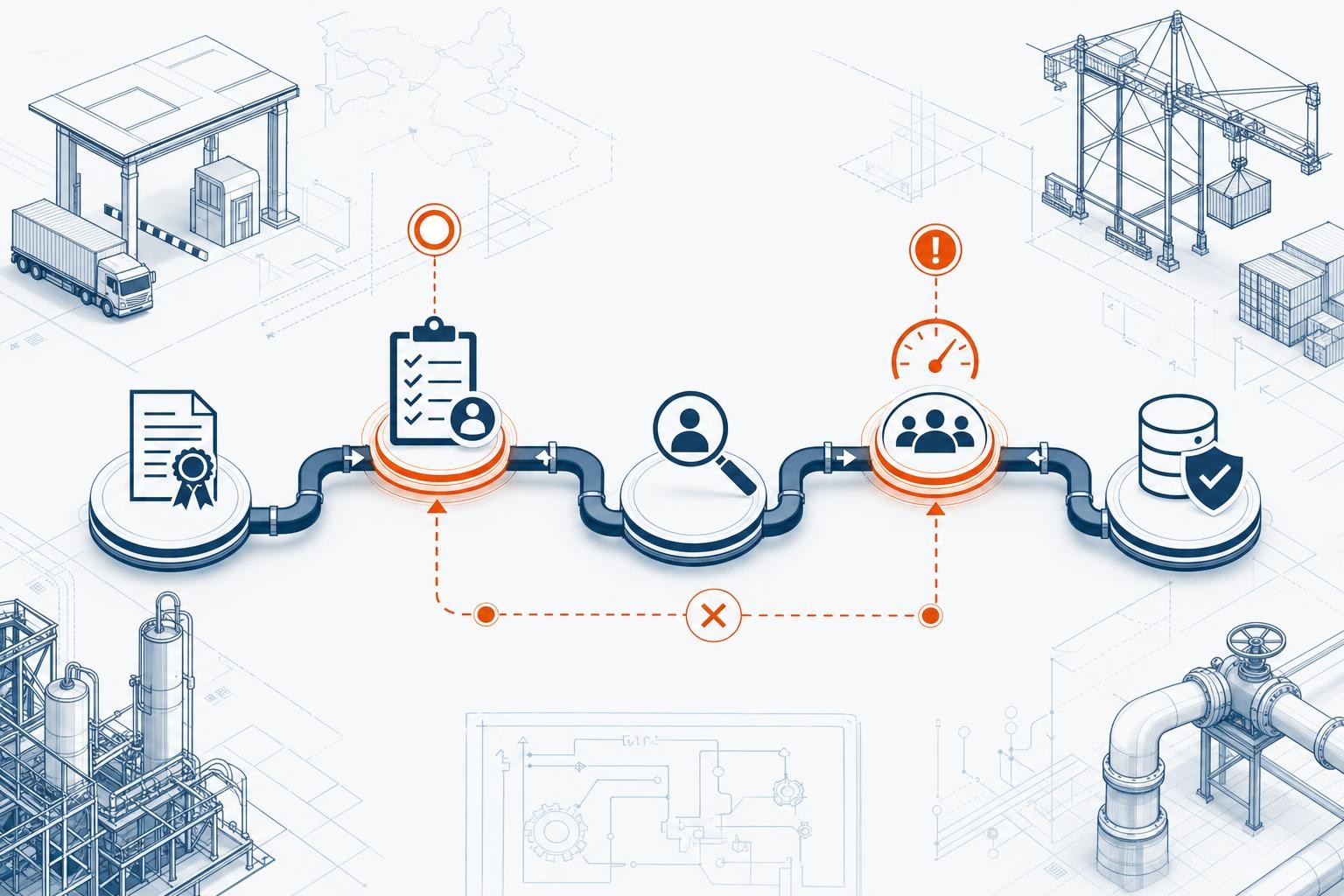
The accreditation-to-Registry pipeline, step by step
The route from "prospective verifier" to "issuing verification reports" has several gates, and they must be passed in sequence.
The verifier must first obtain CBAM accreditation from a National Accreditation Body (NAB) of an EU member state. EU-based verifiers apply to their own country's NAB; verifiers established outside the EU must find an EU NAB that accepts third-country applicants. Accreditation is granted under Commission Delegated Regulation (EU) 2025/2551 and is a multi-month process involving competence assessments, office audits, and witness audits.
Once accredited, the verifier creates an EU Login account and registers in the CBAM Registry via the O3CI portal. This is the technical access step, handled by the Commission. Accredited verifiers can use the O3CI portal from 1 September 2026.
The verifier then applies to be recorded as a registered accredited verifier. This is decided by the NCA of the verifier's accreditation country, which checks that the verifier is duly accredited before granting access.
Verifiers must register in the CBAM Registry within two months of receiving their CBAM accreditation — but not before 1 September 2026. Miss the two-month window and the obligation to register does not disappear; it simply means the verifier is late.
Only once registered as an accredited verifier in the Registry can the verifier connect with non-EU installation operators, review their emissions data and supporting evidence, and issue verification reports. That functionality opens in January 2027.
The sequencing matters because each step depends on the one before it. A verifier that has not yet received NAB accreditation cannot register. A verifier that has not registered cannot issue reports. And no report can be issued in the Registry before January 2027 regardless of how early a verifier completes the earlier steps.
Why January 2027 is the real constraint
Starting from January 2027, accredited verifiers will issue verification reports in the CBAM Registry, thus allowing importers to use actual verified emissions to complete their CBAM declaration. That is the Commission's own formulation, stated in the 24 August guidance announcement.
The first annual CBAM declaration, covering 2026 imports, is due 30 September 2027, with certificates surrendered at the same time.
Put those two dates together and the arithmetic is straightforward: the window in which verification reports can be issued for 2026 imports runs from January to September 2027 - roughly nine months. That is not a comfortable runway. It is a hard constraint with a hard deadline at the end of it.
It is also worth being precise about what is being verified and by whom. The verifier does not verify the importer's declaration. It verifies the operator's emissions report for the non-EU installation that produced the goods. The importer relies on that verified report; it does not commission verification of its own import. This means the importer's ability to use actual emissions depends entirely on whether the operator of each relevant installation has engaged an accredited verifier, completed the verification process, and had the report issued in the Registry in time.
The importer does not commission verification of its own import. The verifier checks the operator's emissions report for the non-EU installation. If your supplier has not engaged an accredited verifier, you cannot substitute one yourself. Your leverage is in asking the right questions now — not in acting unilaterally later.
The capacity arithmetic
The verifier pool is still forming. As of 24 July 2026, 24 national accreditation bodies had agreed to provide CBAM accreditation and 13 were ready to accept applications. Seven had agreed to accredit verification companies established outside the EU, while four were already accepting those applications. Critically, the July state-of-play table records whether NABs can accept applications - it does not report completed accreditations or available audit teams.
The Commission expects the first CBAM verifiers to receive accreditation around September 2026. That means the pool of accredited verifiers is, at the time of writing, still at or near zero. Every verifier that will issue a report for 2026 imports is either in the accreditation process now or has not yet started it.
Against that supply, consider the demand side. Thousands of authorised declarants across the EU are importing CBAM goods from installations spread across China, India, Turkey, the UAE, Ukraine, and dozens of other third countries. Each installation requires a separate verification engagement. And accreditation is not a single blanket qualification: Commission Delegated Regulation (EU) 2025/2551 Annex I establishes twelve distinct CBAM accreditation activity groups, meaning a verifier accredited for iron and steel products does not automatically hold authority to verify upstream sintered ore, pig iron, or crude steel. Each is a separate accreditation scope.
Add to this the practical demands of verification itself. The guidance makes clear that verification takes place at installation level, not at the level of a supplier certificate or a data export. The verifier assesses how the non-EU installation defines its production boundary, measures emissions, and controls the data reported to the authorised declarant. Site visits - physical or remote - are part of the process. For installations in distant third countries, scheduling, travel, and evidence review all take time.
The first year also carries a learning curve. Verifiers are applying new rules under new accreditation schemes. Operators are preparing emissions reports for the first time. The data quality and documentation standards that experienced EU ETS verifiers take for granted do not yet exist uniformly across non-EU installations. Expect the first verification engagements to take longer than subsequent ones.
What importers should do in Q4 2026
The nine-month window opens in January 2027. The preparation work belongs in Q4 2026.
Map your verification exposure. Go through your supplier list and identify every installation whose emissions you intend to declare on actual values. This is not the same as your supplier list: one supplier may operate multiple installations, and one installation may produce goods across several CN codes. The verification engagement is at installation level, so that is the unit of planning.
Ask your suppliers which verifier they intend to engage - and whether that verifier is accredited yet. This is the most important question you can ask right now. If your supplier has not yet identified a verifier, or if the verifier they have in mind is not yet accredited, that is a material risk to your ability to use actual emissions in your declaration. You cannot force your supplier to act, but you can make clear that the commercial relationship depends on it.
Get named in or sighted on the engagement. The verification report is issued by the verifier to the operator, and the operator makes it available to the authorised declarant through the Registry. You do not need to be a party to the verification contract, but you should know who the verifier is, what the scope covers, and when the report is expected. If you are a significant customer of the installation, you have standing to ask.
Build a fallback plan on default values. For every installation where verification is uncertain, model what the default-value cost looks like. Default values are not subject to third-party verification, but they carry a deliberate mark-up that increases your certificate obligation. The mark-up rises from 10% in 2026 to 20% in 2027 and 30% in 2028. For high-emission production routes - blast furnace steel, clinker-heavy cement, primary aluminium - the gap between a verified actual value and a marked-up default can be substantial.
Diarise a data-readiness checkpoint before January 2027. Verification cannot begin until the operator has a complete emissions report ready for the verifier to review. If your supplier's monitoring plan is incomplete, their production data is inconsistent, or their CN-code assignments are unclear, the verifier will flag it and the engagement will stall. A checkpoint in November or December 2026 - asking suppliers to confirm their data is ready - gives you time to intervene before the window opens.
Who does not need to worry as much
Not every importer faces this problem with the same urgency.
Under Regulation (EU) 2025/2083, a uniform exemption threshold of 50 tonnes per importer per calendar year applies to cement, iron and steel, aluminium, and fertilisers - though electricity and hydrogen are excluded from this exemption regardless of quantity. If your total annual imports of covered goods (excluding electricity and hydrogen) stay below that threshold, you fall outside CBAM obligations entirely. No declaration, no certificates, no verification needed.
Importers who are content to use default values also face a simpler picture. Defaults do not require third-party verification. If your embedded emissions are genuinely close to the default, or if the cost difference between actual and default is small relative to the administrative burden of verification, the default route may be the rational choice - provided you have modelled the mark-up and budgeted for it.
The importers who face the sharpest capacity risk are those importing significant volumes of goods with high actual-versus-default gaps: primary aluminium, blast-furnace steel, ammonia-based fertilisers, and cement from clinker-heavy producers. For those goods, the financial case for verified actual emissions is strongest, and the competition for verifier capacity will be most intense.
What to watch
The pace at which NABs accredit verifiers country by country is the leading indicator. The Commission has committed to publishing the list of accredited CBAM verifiers on its CBAM verification page as accreditations are granted. Watch that list. If it remains short through October and November 2026, the capacity crunch in early 2027 will be severe.
Also watch for any Commission communication on verifier capacity or guidance on prioritisation. The August publications are operational documents; they do not address what happens if the verifier pool is simply too small to process all the verification requests before 30 September 2027. That question has not yet been answered publicly.
The Registry itself is the other thing to monitor. The CBAM Registry page carries the access procedure and will reflect updates as the verifier registration process matures. If you have suppliers whose operators have not yet registered in the Registry, that is a prerequisite for the verification workflow to function at all.
The verifier market is not a background compliance detail. For importers planning to use actual emissions, it is the critical path. The window is nine months. It opens in January 2027. The preparation belongs now.
This article is general information, not legal or compliance advice. CBAM rules and guidance are detailed and subject to change; confirm specifics against the official CBAM legal texts and Commission guidance before acting.
Related reading
Who Can Actually Accredit Your Supplier's Verifier? Reading the Commission's CBAM Accreditation State-of-Play
The Commission's 25 September accreditation update shows 24 national bodies on board, 15 ready and only 5 taking third-country applications. What that means for suppliers outside the EU and the importers who depend on them.
Norway and Iceland Are Joining CBAM: What the EEA Joint Committee Decisions Change for Importers
On 25 September 2026 the EEA Joint Committee adopted two decisions bringing CBAM to Norway and Iceland. Adoption is not entry into force, though. Here is what is decided, what is pending, and what to watch.
The EU-India Trade Deal Didn't Buy India a CBAM Exemption: What Steel and Aluminium Importers Should Plan For
The EU-India trade agreement cuts tariffs on most goods, but it leaves CBAM untouched. Here is what that means for importers of Indian steel and aluminium, and what to do before the 2026 declaration.