Who Can Actually Accredit Your Supplier's Verifier? Reading the Commission's CBAM Accreditation State-of-Play
Who Can Actually Accredit Your Supplier's Verifier?
Actual-emissions reporting under CBAM needs an accredited verifier. Accreditation comes from national accreditation bodies, and the Commission's refreshed state-of-play document of 25 September 2026 shows how far that network has come.
The numbers
Per the Commission's state-of-play on CBAM accreditation, as summarised by CBAM Pulse:
- 24 national accreditation bodies have agreed to provide CBAM accreditation.
- 15 are ready to accept applications now.
- 7 have agreed to accredit third-country applicants.
- 5 already accept third-country applications.
France's COFRAC is approved across all four categories, including third-country applications. Romania's RENAR is targeting readiness in October 2026.
Why the third-country column matters
Most CBAM-covered goods are made outside the EU, so the verifiers your suppliers need will often be based, or must be accredited, abroad. Only five bodies currently take third-country applications. That is the narrow end of the funnel, and it sets the pace at which non-EU installations can obtain verified data.
Where this sits in the timeline
The Commission's verification page is the reference point. Recent milestones:
- 24 August 2026: 141-page guidance on verification, accreditation, site visits and reports.
- 28 August 2026: procedures for verifiers to access the CBAM Registry from 1 September 2026.
- January 2027: earliest point verification reports can exist in the Registry, as discussed in our piece on the verifier capacity crunch.
What importers should ask suppliers now
- Which verifier, and accredited by whom? A name and the accrediting body, not a promise.
- Is the verifier's accreditation route open to third-country applicants? If it depends on one of the five, ask about timing.
- When is the site visit planned? Verification needs scheduling, and demand will bunch toward year end.
- What is the fallback? If verified data will not be ready, agree in advance how default values will be handled commercially.
Bottom line
The accreditation network is forming, but capacity for suppliers outside the EU is thin and still opening up. Importers who ask these questions in October have options; those who wait until January may only have default values.
Related reading
Norway and Iceland Are Joining CBAM: What the EEA Joint Committee Decisions Change for Importers
On 25 September 2026 the EEA Joint Committee adopted two decisions bringing CBAM to Norway and Iceland. Adoption is not entry into force, though. Here is what is decided, what is pending, and what to watch.
The EU-India Trade Deal Didn't Buy India a CBAM Exemption: What Steel and Aluminium Importers Should Plan For
The EU-India trade agreement cuts tariffs on most goods, but it leaves CBAM untouched. Here is what that means for importers of Indian steel and aluminium, and what to do before the 2026 declaration.
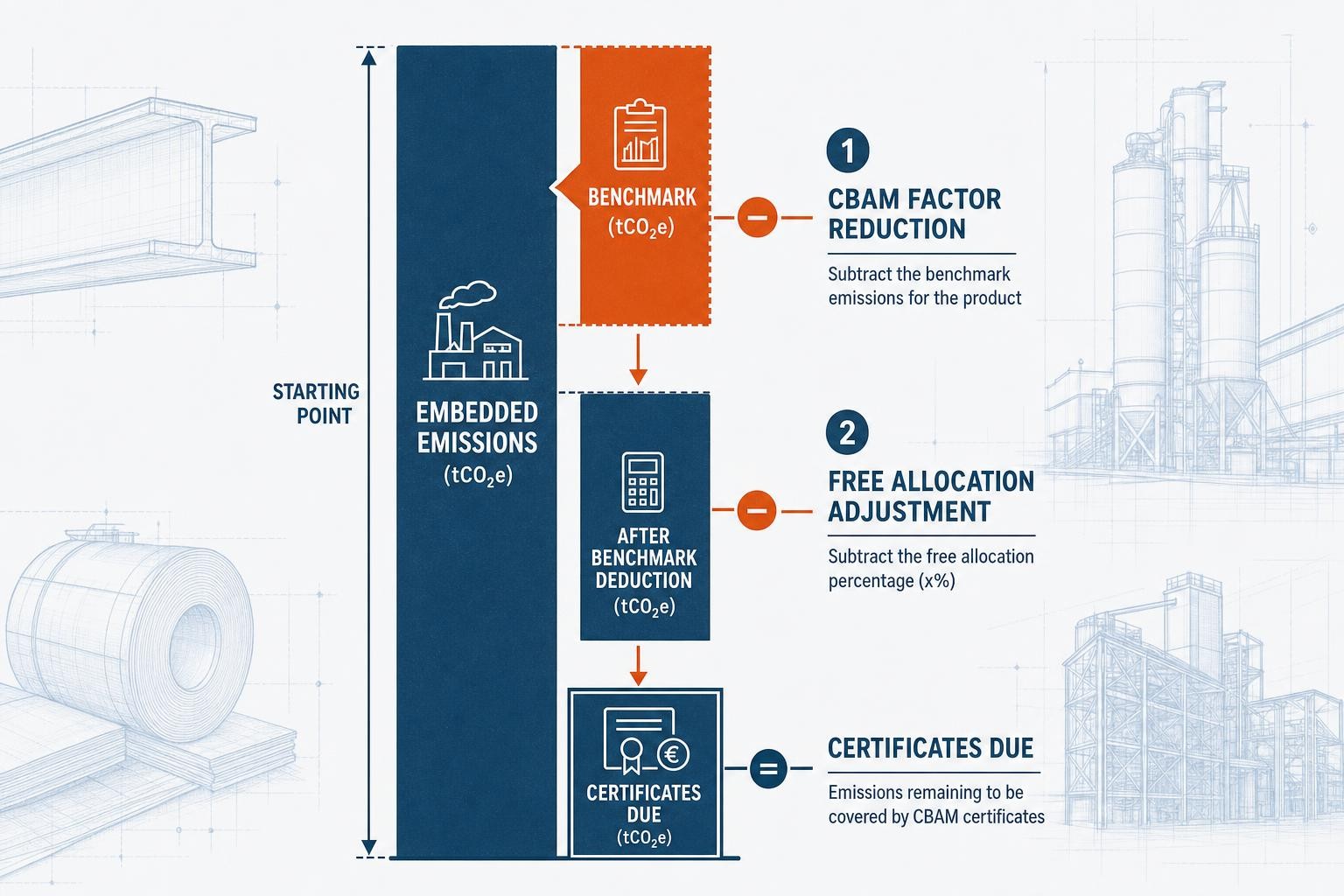
The Two Reductions Nobody Tells You About: CBAM Certificates, the CBAM Factor, and the Free Allocation Adjustment
Your CBAM certificate bill is not simply 2.5% of embedded emissions. There are two distinct reductions - the CBAM factor and the SEFA free allocation adjustment - and conflating them changes the cash number.