The Two Reductions Nobody Tells You About: CBAM Certificates, the CBAM Factor, and the Free Allocation Adjustment
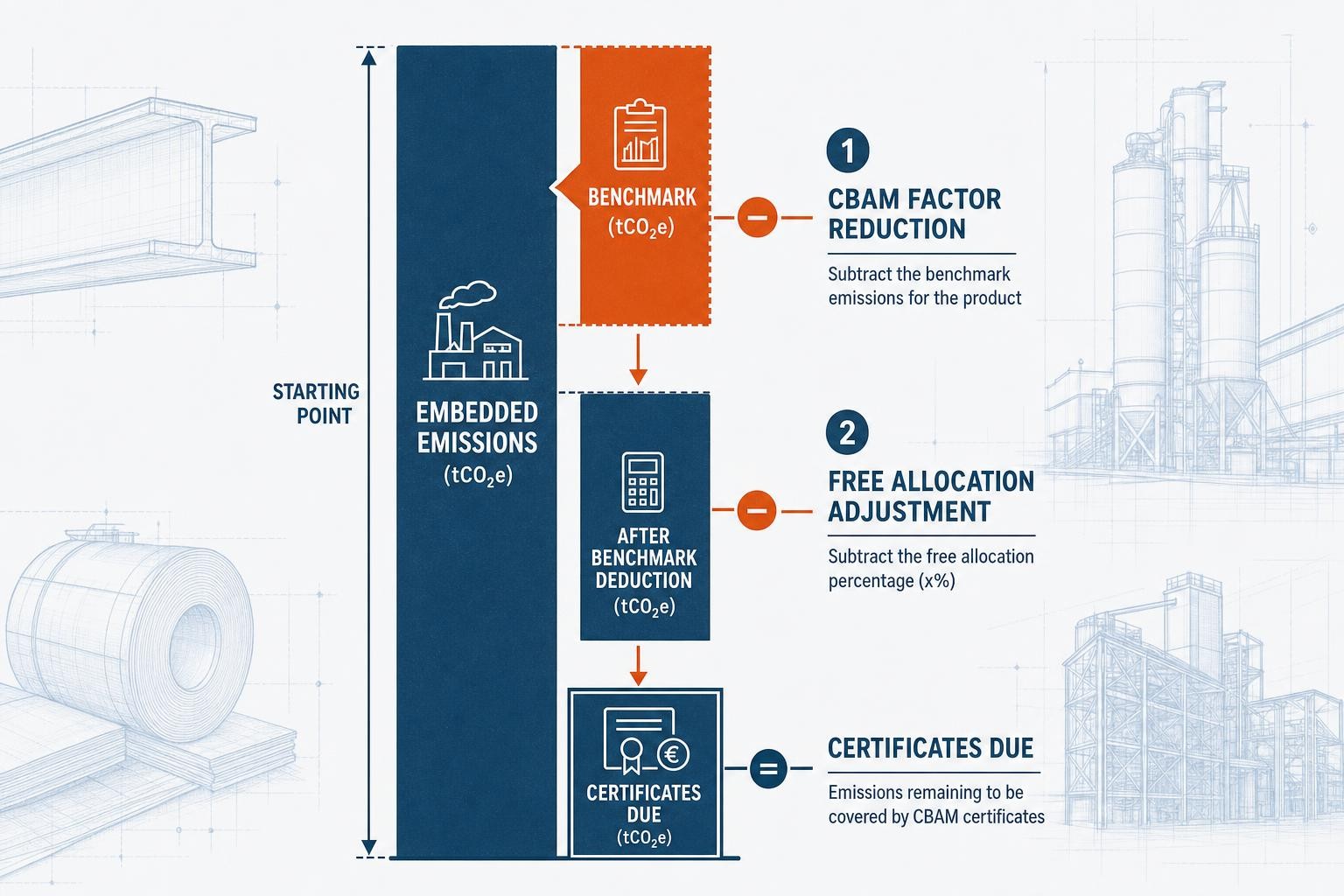
You have probably seen the headline figure: in 2026, CBAM certificates are due on only 2.5% of a shipment's verified embedded emissions. That is true, but it is an incomplete sentence. There is a second reduction sitting between your embedded emissions figure and the certificate count, and it works differently from the first. Getting it wrong - or failing to ask your supplier to calculate it - changes the number of certificates you surrender and, at current ETS prices, the euros you spend.
On 14 August 2026, the European Commission published a series of ten guidance documents to support CBAM implementation in the definitive period. The package covers general methodology, embedded-emissions calculation, and six sector-specific guides for cement, hydrogen, fertilisers, iron and steel, aluminium, and electricity. Guidance No 4 in that series is the first official document dedicated to the free allocation adjustment - the mechanic that sits between your gross embedded emissions and the certificate obligation. Until that document appeared, declarants had to piece the calculation together from the primary regulation and several implementing acts.
This post is about that mechanic, at the level of a single consignment. It is not a repeat of the phase-out schedule or the guidance overview; it is a working explanation of why "2.5% of emissions" is only half the story.
The calculation chain, step by step
Before naming the two reductions, it helps to see the full chain. Starting from an installation's embedded emissions and ending at certificates surrendered, the steps are:
- Specific embedded emissions (SEE) - the verified (or default) tCO₂e per tonne of product, covering direct emissions and, for some sectors, indirect emissions from electricity use.
- Minus any carbon price effectively paid in the country of production - a separate deduction, covered in our earlier post on third-country carbon price deductions, and only available when actual values are used.
- Minus the free allocation adjustment - the SEFA deduction (or its default-benchmark equivalent). This is the subject of this post.
- Multiplied by the CBAM factor - the policy-level phase-in percentage, currently 2.5% for 2026 imports.
- Multiplied by the quantity imported - to give total certificates due for the consignment.
Steps 3 and 4 are the two reductions. They are separate in origin, separate in calculation, and separate in what data you need from your supplier. Most of the confusion in the market comes from treating them as one.
This post simplifies the ordering slightly for clarity. In the legal text, the free allocation adjustment and the CBAM factor interact through the SEFA formula rather than as two sequential subtractions. The practical effect described here is accurate for planning purposes; the official methodology in Commission Implementing Regulation (EU) 2025/2620 and Guidance No 4 governs for declaration purposes.
Reduction one: the CBAM factor
In 2026, EU ETS free allocation for CBAM-covered sectors stands at 97.5%, so the CBAM factor is 2.5% - certificates are due on only 2.5% of verified embedded emissions of 2026 imports. The factor rises each year as free allocation phases out, reaching 100% on 1 January 2034.
This reduction is a policy-level phase-in. It is the same percentage for every importer, every sector, and every country of origin in a given year. You do not calculate it; you look it up. It is the number that drives the "your CBAM bill doubles by 2030" narrative, and it is well understood.
What is less well understood is that the CBAM factor is not the only thing standing between gross embedded emissions and the certificate bill.
Reduction two: the free allocation adjustment (SEFA)
The free allocation adjustment exists because of a fairness principle baked into the CBAM design. An EU steelmaker, cement producer, or fertiliser manufacturer still receives a share of EU ETS allowances at no charge. As long as that is true, charging an importer for 100% of the equivalent carbon cost would give EU producers a competitive advantage that CBAM is not supposed to create. The adjustment corrects for that.
Commission Implementing Regulation (EU) 2025/2620 establishes the SEFA (Specific Embedded Free Allocation) methodology, which calculates the CBAM certificate reduction attributable to EU ETS free allocation received by competing domestic EU producers.
In plain terms: SEFA is the free allocation that an equivalent EU installation would receive under the ETS benchmark for that good, expressed per tonne of product. It is subtracted from the certificate obligation so that the imported good is charged only for the emissions an EU producer would actually pay for - not the emissions that EU producers are still getting for free.
Unlike the CBAM factor, SEFA is not the same for everyone. It varies by:
- Sector and production route - the ETS benchmark for blast-furnace steel is different from that for electric-arc furnace steel, and different again from the benchmark for grey hydrogen.
- Whether you are using actual or default values - this is the fork in the road that most importers have not yet mapped.
- The cross-sectoral correction factor (CSCF) applicable under the EU ETS for the reporting year - a technical multiplier that adjusts the benchmark allocation downward when total free allocation across the ETS exceeds the cap.
Actual values versus default values: two different SEFA paths
This is where the practical complexity lives, and where supplier data requests need to change.
If you are using actual verified emissions
When a third-country operator provides actual monitored emissions data, they must also calculate the SEFA for the goods they produce. For a simple good (a single production process), the SEFA calculation uses three inputs: the CBAM factor for the reporting year, the cross-sectoral correction factor, and the process-related CBAM benchmark value from Implementing Regulation (EU) 2025/2620.
For complex goods - those with precursors that themselves carry embedded emissions - the SEFA must also incorporate the free allocation embedded in each precursor, calculated recursively through the production chain.
The key implication: your supplier data request now has two components, not one. You need the embedded emissions figure, and you need the SEFA figure. If your current template asks only for tCO₂e per tonne of product, it is incomplete.
If you are using default values
When default embedded emissions values are used (from Commission Implementing Regulation (EU) 2025/2621), the corresponding default CBAM benchmark is applied for the free allocation adjustment instead. Implementing Regulation (EU) 2025/2620 publishes two benchmark columns: Column A for use with actual data, and Column B for use with default calculations, with the assumed production route and precursor effects already incorporated.
The practical effect is that the default path is self-contained: you use the default emissions figure and the Column B benchmark, and you do not need the supplier to calculate a SEFA. The trade-off is that default values carry a mark-up - 10% above country-specific averages in 2026, rising to 20% in 2027 and 30% from 2028 onward - and that mark-up compounds as the CBAM factor rises.
Worked example: the same consignment, two paths
The numbers below are illustrative only and are not a substitute for the official methodology. They use round figures to show where the two paths diverge. Assume a consignment of 1,000 tonnes of a covered good with the following characteristics:
| Input | Value |
|---|---|
| Quantity imported | 1,000 t |
| Gross embedded emissions (actual path) | 2.00 tCO₂e / t |
| Gross embedded emissions (default path) | 2.20 tCO₂e / t (includes 10% mark-up) |
| CBAM factor (2026) | 2.5% |
| SEFA - actual path (Column A benchmark × CBAM factor × CSCF) | 0.30 tCO₂e / t (illustrative) |
| SEFA - default path (Column B benchmark × CBAM factor) | 0.25 tCO₂e / t (illustrative) |
| EU ETS certificate price | €75 / tCO₂e |
Actual values path:
- Gross embedded emissions: 2.00 × 1,000 = 2,000 tCO₂e
- Minus SEFA adjustment: 0.30 × 1,000 = 300 tCO₂e
- Net before CBAM factor: 1,700 tCO₂e
- Apply CBAM factor (2.5%): 1,700 × 2.5% = 42.5 certificates
- Certificate cost at €75: €3,188
Default values path:
- Gross embedded emissions: 2.20 × 1,000 = 2,200 tCO₂e
- Minus SEFA adjustment: 0.25 × 1,000 = 250 tCO₂e
- Net before CBAM factor: 1,950 tCO₂e
- Apply CBAM factor (2.5%): 1,950 × 2.5% = 48.75 certificates
- Certificate cost at €75: €3,656
The difference in this example is modest in 2026 - roughly €468 per 1,000 tonnes. Apply the same gap to a 2030 CBAM factor of 48.5% and the same ETS price, and the difference on the same consignment becomes approximately €9,000. The SEFA calculation matters more, not less, as the phase-in advances.
Why this compounds towards 2034
The CBAM factor and the SEFA deduction move in opposite directions over time, and that interaction is easy to miss.
As the CBAM factor rises - from 2.5% in 2026 to 100% in 2034 - the certificate obligation grows. At the same time, EU domestic producers are losing their free allocation at the same rate. That means the SEFA deduction, which reflects the free allocation still in place, shrinks in parallel. By 2034, when free allocation reaches zero, SEFA also reaches zero and the adjustment disappears entirely.
The result is a double squeeze: more certificates are due on a larger share of emissions, and the deduction that was reducing the bill is gone. This is the intended design - CBAM and the ETS phase-out are coupled so that the competitive position between EU and non-EU producers remains approximately stable throughout the transition. But for an importer's cash flow model, the two effects compound rather than cancel.
The practical planning implication: do not model your 2030 or 2034 CBAM exposure using the 2026 SEFA deduction. The deduction will be smaller in proportion to the certificate obligation every year.
What to do now: four practical actions
1. Update your supplier data request template.
If your current template asks only for embedded emissions (tCO₂e per tonne), it is missing the SEFA component. For suppliers providing actual values, you need them to calculate and report the process-level specific free allocation alongside the emissions figure. This is a new ask for most non-EU operators, and it takes time to set up correctly.
2. Check your CBAM software or spreadsheet.
Ask your software provider or whoever built your compliance spreadsheet whether the free allocation adjustment is implemented as a separate step from the CBAM factor. If the tool applies only the CBAM factor percentage to gross emissions, it is not calculating the certificate obligation correctly. The two reductions are not interchangeable.
3. Ask your verifier how they treat SEFA.
Verifiers review both the emissions intensity figures and the benchmark data. If your supplier's emissions report does not include a SEFA calculation, the verifier cannot confirm it. Raise this explicitly before the verification engagement begins, not after.
4. Reconcile any vendor-produced certificate estimate against the four-step chain.
If a broker, software tool, or adviser has given you a certificate estimate, ask them to show the working: gross emissions, minus SEFA, multiplied by the CBAM factor, multiplied by quantity. If the working does not show SEFA as a separate line, the estimate may be understating or overstating your obligation.
What to watch next
The August guidance package is explanatory and non-binding - it translates the legal obligations in Implementing Regulation (EU) 2025/2620 and the primary CBAM Regulation into worked examples and decision trees. The obligations themselves have applied since 1 January 2026.
Two things are worth watching in the months ahead. First, the Commission has indicated that default values and mark-ups will be reviewed, with a preference for completing that review in 2026. Any revision to the Column B benchmarks in Implementing Regulation (EU) 2025/2620 would change the SEFA deduction on the default path. Second, sector-specific guidance (Guidance Nos 5a to 5f) contains production-route detail that affects which CBAM benchmark applies to your goods - and therefore which SEFA figure flows into the calculation. If you import steel, aluminium, or fertilisers, the sector guide for your product is the next document to read alongside Guidance No 4.
The guidance series is available on the Commission's CBAM legislation and guidance page.
This article is general information, not legal or tax advice. The official methodology is set out in Regulation (EU) 2023/956, Commission Implementing Regulation (EU) 2025/2620, and the Commission's Guidance No 4 published 14 August 2026. Confirm all figures and calculations against those primary sources before use in a CBAM declaration.
Related reading
Who Can Actually Accredit Your Supplier's Verifier? Reading the Commission's CBAM Accreditation State-of-Play
The Commission's 25 September accreditation update shows 24 national bodies on board, 15 ready and only 5 taking third-country applications. What that means for suppliers outside the EU and the importers who depend on them.
Norway and Iceland Are Joining CBAM: What the EEA Joint Committee Decisions Change for Importers
On 25 September 2026 the EEA Joint Committee adopted two decisions bringing CBAM to Norway and Iceland. Adoption is not entry into force, though. Here is what is decided, what is pending, and what to watch.
The EU-India Trade Deal Didn't Buy India a CBAM Exemption: What Steel and Aluminium Importers Should Plan For
The EU-India trade agreement cuts tariffs on most goods, but it leaves CBAM untouched. Here is what that means for importers of Indian steel and aluminium, and what to do before the 2026 declaration.