CBAM Penalties Explained: What EU Importers Risk in the Definitive Period
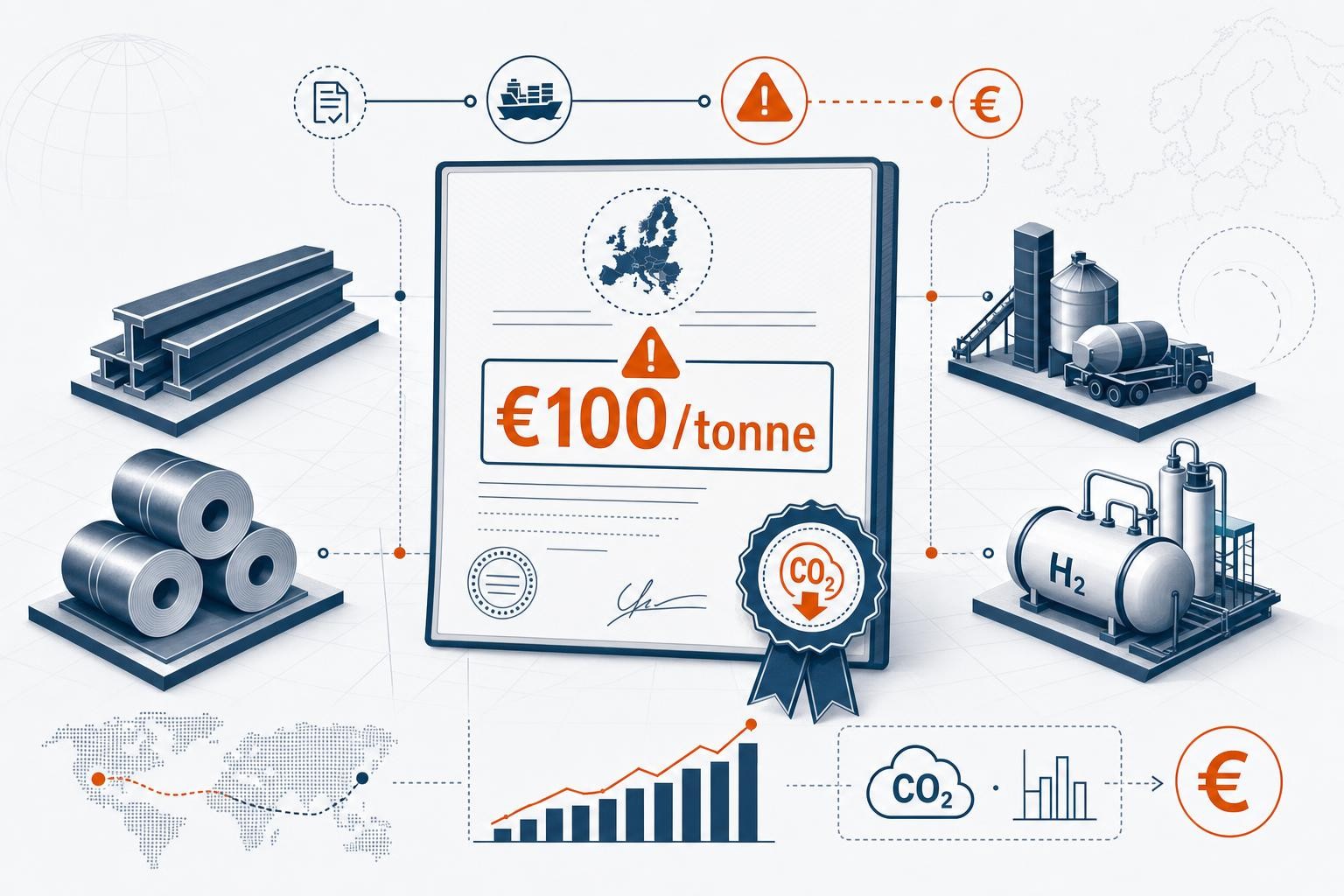
The transitional phase is over. Since 1 January 2026, the EU Carbon Border Adjustment Mechanism has real financial teeth - and the penalty structure is deliberately modelled on the toughest carbon enforcement regime in Europe: the EU Emissions Trading System.
This guide explains exactly what triggers a penalty, how much it costs, what paying it does not get you out of, and what you can do right now to stay on the right side of the rules.
The headline penalty: €100 per tonne, indexed to inflation
Under Article 26(1) of Regulation (EU) 2023/956, an authorised CBAM declarant who fails to surrender the required number of certificates by the annual deadline faces a penalty of €100 for each tonne of embedded emissions for which certificates were not surrendered. This figure is not arbitrary - it is identical to the excess-emissions penalty under the EU ETS (Article 16(3) of Directive 2003/87/EC), and like the ETS figure it is indexed to European inflation, so the real-terms bite stays constant over time.
The penalty applies per certificate not surrendered - so a shortfall of 5,000 tonnes means a minimum fine of €500,000, before any inflation adjustment.
Paying the penalty does NOT clear the debt. Under Article 26(3) of Regulation (EU) 2023/956, payment of the fine does not release an authorised CBAM declarant from the obligation to surrender the outstanding certificates. You pay the fine and you still owe the certificates. This is the single most important thing to understand about CBAM enforcement.
What triggers a penalty
There are two distinct compliance obligations that can generate a penalty, and they run on different clocks.
1. Missing the annual surrender deadline
The first annual CBAM declaration and certificate surrender deadline is 30 September 2027, covering embedded emissions from all CBAM goods imported during 2026. After that, the deadline is 30 September every year. If you have not surrendered enough certificates to cover your verified embedded emissions by that date, your National Competent Authority (NCA) can impose the €100/tonne penalty.
Note the practical timeline: CBAM certificate sales via the EU's centralised common platform open on 1 February 2027 - so there is no obligation to hold certificates during 2026 itself, but you will need to move quickly once the market opens.
2. Breaching the quarterly holding rule
From 2027 onwards, there is a second, ongoing obligation that runs throughout the year. Authorised CBAM declarants must ensure that, at the end of each quarter (31 March, 30 June, 30 September, and 31 December), their CBAM Registry account holds certificates covering at least 50% of the embedded emissions of all goods imported since the start of the calendar year. This was reduced from the originally planned 80% threshold by the Omnibus simplification (Regulation (EU) 2025/2083), but it remains a live quarterly test - not just an annual one.
Failing to maintain the 50% position at any quarter-end is a separate compliance failure from the annual surrender shortfall, and can be assessed independently by your NCA.
A separate, harsher track: importing without authorisation
The €100/tonne figure applies to authorised declarants who fall short. If you import CBAM goods above the 50-tonne annual threshold without having obtained authorised declarant status at all, you face a fundamentally different - and much steeper - penalty regime.
Under Article 26(2) of Regulation (EU) 2023/956, a person who imports CBAM goods without complying with the authorisation obligations faces a penalty of three to five times the standard €100/tonne rate - i.e. €300-€500 per tonne of embedded emissions. The exact multiplier depends on the duration, gravity, scope, intentional nature and repetition of the non-compliance, and the level of cooperation with the competent authority.
Mayer Brown's analysis of the Omnibus simplification confirms this: if an importer exceeds the 50-tonne mass-based threshold without authorised CBAM declarant status, penalties apply amounting to three to five times the standard penalty of EUR 100 per tonne of embedded emissions.
One important distinction: for unauthorised importers, paying the penalty does release them from the obligation to submit a CBAM declaration and surrender certificates - the inverse of the rule that applies to authorised declarants.
Mitigation: when penalties can be reduced
The penalty regime is not entirely binary. The Omnibus simplification introduced explicit grounds for reduction that NCAs can apply at their discretion.
Third-party data errors. The competent authority may reduce the penalty where the failure results from incorrect information provided by a third party - such as a non-EU operator, an accredited verifier, or an independent certifying person. This matters because CBAM compliance is structurally dependent on emissions data generated upstream in your supply chain.
Minor, unintentional, or first-time failures. Mayer Brown notes that under the revised regulation, penalties for non-compliance are harmonised with the EU ETS excess emissions penalty regime (EUR 100 for each tonne of embedded emissions), with reductions possible for minor or unintentional errors. Norton Rose Fulbright's analysis adds that the relevant clause is phrased in a discretionary way - the competent authority may decrease the amount, taking into account factors including the extent of the unreported information, the level of cooperation, the readiness, the unintentional nature of the behaviour, and the past compliance record of the declarant.
Proportionality is built in. The Regulation requires that penalties be "effective, proportionate and dissuasive." NCAs administer enforcement under national law, and the Commission facilitates information-sharing across Member States - but the day-to-day decision on whether and how much to penalise sits with your national authority.
Proactive correction helps. If you identify a shortfall before your NCA does, contact your competent authority promptly. Voluntary disclosure, cooperation, and a clear remediation plan are all factors that can influence the penalty outcome. Waiting to be caught is the worst strategy.
How authorities estimate emissions if you under-report
If your declaration under-reports embedded emissions - or if verification fails - the competent authority does not simply accept the lower figure. The Commission conducts an initial review of all declarations and can flag incomplete or suspect submissions to the relevant NCA, which then decides whether to initiate a formal correction procedure.
Where a declarant has not taken the necessary steps to correct a deficient declaration, the NCA can impose its own estimate of the embedded emissions. From 2026 onwards, definitive-period default values are set at the average emission intensity of each exporting country, increased by a proportionately designed mark-up. These mark-up defaults are deliberately conservative - they are designed to be higher than actual verified emissions for most installations, which means under-reporting and relying on authority estimates is almost always more expensive than getting verified data right.
Five practical steps to stay compliant
Only authorised CBAM declarants may import covered goods above the 50-tonne annual threshold. If you have not yet applied, do so immediately — importers who submitted applications by 31 March 2026 may continue importing provisionally while their application is processed. Check your status in the CBAM Registry's Authorisation Management Module.
Set internal calendar reminders for 31 March, 30 June, 30 September, and 31 December each year. By each of those dates, your Registry account must hold certificates covering at least 50% of cumulative embedded emissions since 1 January. The quarterly holding obligation accounts for the free-allocation adjustment under the EU ETS.
Certificate sales via the centralised EU platform open on 1 February 2027. Prices for 2026 imports are based on the quarterly average EU ETS auction clearing price for each quarter of 2026 — the Q1 2026 price was published at €75.36 per certificate. Don't wait until September to start buying.
Your annual declaration must be filed and certificates surrendered by 30 September 2027. Accredited third-party verification of actual emissions is required when using actual values. If your supplier data is incomplete, you will fall back on conservative default values — costing you more certificates and more money.
Keep records of all emissions data requests to suppliers, verification reports, and certificate transactions. If you identify a likely shortfall, contact your NCA before the deadline. Cooperation and transparency are explicit mitigating factors under the penalty regime.
Penalty comparison at a glance
| Scenario | Who it applies to | Penalty rate | Does paying clear the certificate obligation? |
|---|---|---|---|
| Insufficient certificate surrender by 30 Sept deadline | Authorised CBAM declarants | €100/tonne of embedded emissions (inflation-indexed) | No — certificates must still be surrendered |
| Breach of quarterly 50% holding rule | Authorised CBAM declarants | Assessed by NCA under Art. 26(1) framework | No — position must be corrected |
| Importing without authorised declarant status | Any importer above 50-tonne threshold | €300–€500/tonne (3–5× standard rate) | Yes — penalty payment releases declaration/surrender obligation |
| Minor / unintentional / first-time shortfall | Authorised CBAM declarants | Reduced at NCA discretion | No — certificates must still be surrendered |
The bottom line
CBAM penalties are not a rounding error. A mid-sized steel importer bringing in 10,000 tonnes of goods with an average embedded intensity of 1.8 tCO₂e per tonne faces a potential exposure of €1.8 million in fines for a full surrender failure - before the cost of the certificates themselves. The double-jeopardy structure - fine plus certificates - is intentional: it removes any financial logic to non-compliance.
The good news is that the compliance path is clear. Get authorised, track the quarterly position, buy certificates early in 2027, and get your supplier emissions data verified. The deadline of 30 September 2027 is further away than it looks - but the data work for 2026 imports is happening right now.
Independent guide. Not legal advice. The authoritative source is Regulation (EU) 2023/956 as amended by Regulation (EU) 2025/2083, available on EUR-Lex. For jurisdiction-specific enforcement questions, consult your National Competent Authority or qualified legal counsel.
Want fortnightly updates on CBAM certificate prices, rule changes, and compliance deadlines? Subscribe to The CBAM Brief - free, no spam.
Related reading
Who Can Actually Accredit Your Supplier's Verifier? Reading the Commission's CBAM Accreditation State-of-Play
The Commission's 25 September accreditation update shows 24 national bodies on board, 15 ready and only 5 taking third-country applications. What that means for suppliers outside the EU and the importers who depend on them.
Norway and Iceland Are Joining CBAM: What the EEA Joint Committee Decisions Change for Importers
On 25 September 2026 the EEA Joint Committee adopted two decisions bringing CBAM to Norway and Iceland. Adoption is not entry into force, though. Here is what is decided, what is pending, and what to watch.
The EU-India Trade Deal Didn't Buy India a CBAM Exemption: What Steel and Aluminium Importers Should Plan For
The EU-India trade agreement cuts tariffs on most goods, but it leaves CBAM untouched. Here is what that means for importers of Indian steel and aluminium, and what to do before the 2026 declaration.