Inside the July 2026 Draft Rules: How CBAM Certificate Buying and Repurchase Will Actually Work
The European Commission has finally put operational flesh on the bones of CBAM certificate management. On 9 July 2026, the Commission opened a public consultation on a draft delegated regulation setting out how the sale and repurchase of CBAM certificates will operate. The draft is open for feedback until 6 August 2026 and is not yet adopted. If it clears that process and is finalised on schedule, the regulation will apply from 1 February 2027.
This post focuses on the mechanics that matter most to finance and treasury teams: how purchases flow through the system, what the repurchase cap means for your cash position, and why the shift to weekly pricing from 2027 changes the timing calculus entirely.
Everything in this post that references the draft delegated regulation reflects a draft text that has not yet been adopted. Treat operational details — platform flows, fee levels, request limits — as subject to change until the final act is published in the Official Journal. The adoption is planned for Q4 2026.
The buying flow: registry request -> central platform -> euro payment
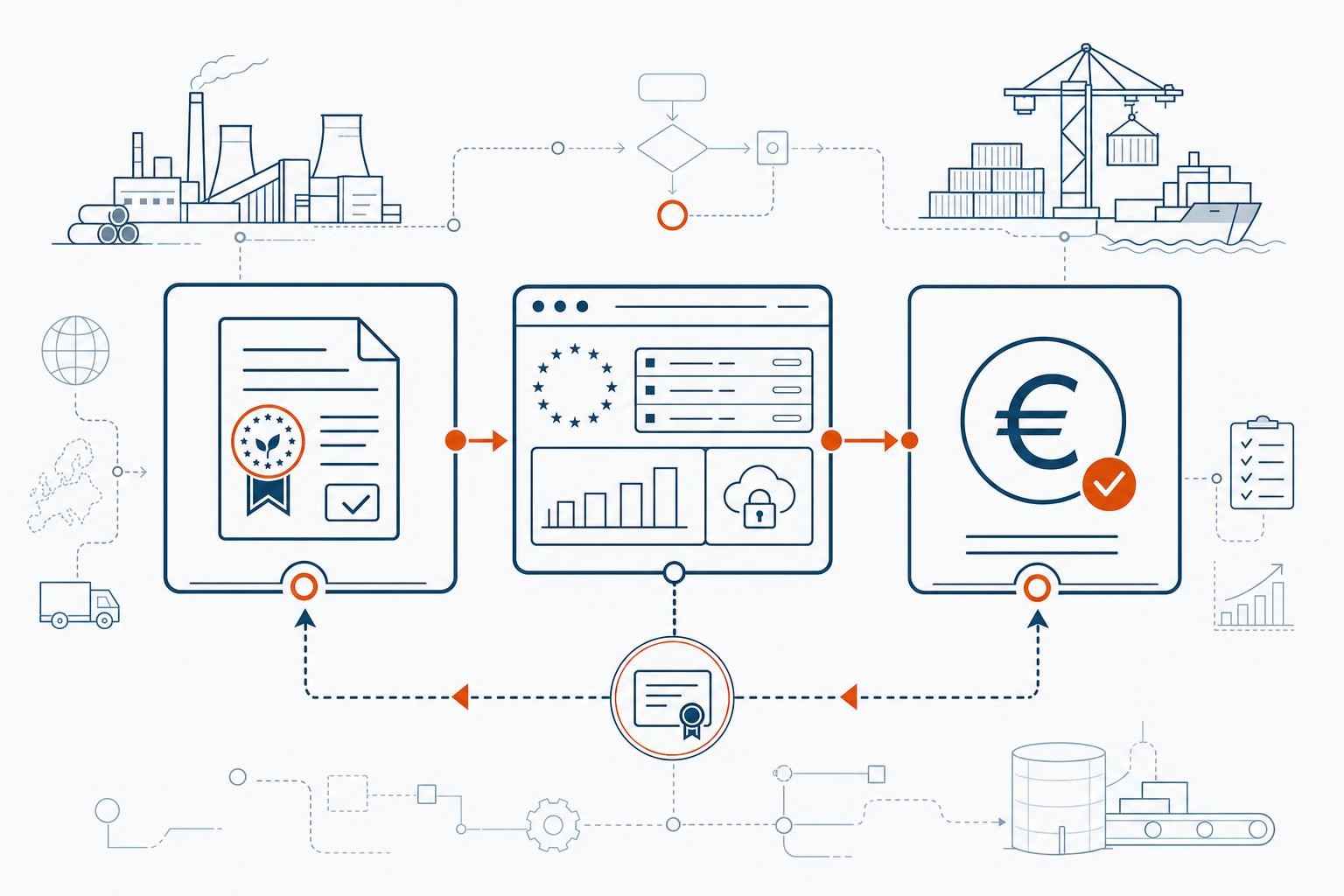
Under the draft regulation, the CBAM Registry and the common central platform will perform separate functions. The CBAM Registry serves as the electronic system for submitting CBAM declarations and managing the issuance, holding, surrender, and cancellation of certificates. The central platform handles the money.
CBAM certificates cannot be bought via a market. From 1 February 2027, authorised CBAM declarants enter a purchase request into the CBAM Registry specifying the number of certificates to buy. That request is then transferred to the Common Central Platform, through which EU Member States sell the certificates to declarants.
Each purchase request must specify between 1 and 99,999 certificates, together with the applicable certificate price, fees, and total payment amount. Need more than 99,999? You submit multiple requests. There is no minimum holding period between requests, so you can buy in tranches across the year.
All purchase and repurchase payments must be made exclusively in euro. Non-eurozone importers will need to factor in FX conversion costs and timing when budgeting. The draft also specifies a fixed fee of €0.05 per certificate.
Unlike the EU ETS, CBAM will not function as a cap-and-trade system. Consequently, there will be no limit on the number of certificates Member States may sell, and they will not be permitted to delay or restrict sales. Each certificate will be assigned exclusively to the purchasing declarant, carry a unique identification number, and will not be transferable or tradable.
Repurchase: the cap that limits your cash-back
Buying too many certificates is not a neutral mistake - it ties up working capital with only a capped route to recovery.
The authorised CBAM declarant must submit any repurchase request by 31 October of each year during which CBAM certificates were surrendered. Certificates purchased in 2027 for 2026 imports may only be repurchased in 2027. Declarants may request one repurchase per year.
The repurchase limit for excess CBAM certificates is aligned with the actual purchase obligation for the year - 50% of embedded emissions in all CBAM goods imported. In plain terms: the cap on what you can sell back is tied to your actual compliance obligation, not the total number of certificates you happen to hold. Buy significantly more than you need and a portion of the excess cannot be recovered.
On 1 November of each year, the Commission will cancel, without compensation, any CBAM certificates purchased during the year before the previous calendar year that remain in an account. On 1 November 2027, the Commission will cancel any CBAM certificates purchased in respect of 2026 embedded emissions without any compensation.
The cancellation cliff. Any 2026-year certificates still sitting in your account on 1 November 2027 — after the surrender and repurchase windows have closed — are cancelled with zero compensation. Over-buying is not just an opportunity cost; it is a write-off risk.
Pricing: quarterly in 2026, weekly from 2027 - and why it matters
The methodology ensures that the price of CBAM certificates reflects the average price of EU ETS allowances, maintaining consistency between the carbon cost applicable to EU producers and that applied to imports. The Commission calculates the price as the weighted average of the auction clearing prices of auctioned EU ETS allowances.
For 2026 imports, the price is fixed per quarter. The Q1 2026 CBAM certificate reference price was set at EUR 75.36/tCO₂e, published on 7 April 2026. The Q2 2026 reference price came in at EUR 75.28/tCO₂e, published on 6 July 2026. The Q3 and Q4 2026 prices will be released on 5 October 2026 and 4 January 2027, respectively.
In July 2026, EU carbon prices fluctuated between EUR 79.4 and EUR 82 per tonne. The CBAM reference price for Q2 2026 was set at EUR 75.28 per tonne. The gap between the live ETS price and the official CBAM reference price reflects the quarterly averaging effect - a smoothing mechanism that disappears from 2027.
For imports in 2026, the Commission applies a quarterly CBAM certificate price based on volume-weighted EU ETS auction clearing prices. From 1 January 2027, the Commission will calculate a weekly CBAM certificate price.
What the weekly shift means for timing. In 2026, you know the price for an entire quarter before you buy. From 2027, the price resets every week. That changes the decision from "what is this quarter's price?" to "what will the price be when I submit my next purchase request?" Importers who buy in a single annual lump in early February 2027 lock in whatever the week-one price happens to be. Those who spread purchases across the year can average their cost - but also take on the risk that prices rise.
Treasury and cash-flow: the three risks to plan around
1. Under-buying and the holding rule
From 2027 onwards, an authorised CBAM declarant must ensure that, at the end of each quarter, the number of CBAM certificates held on their account in the CBAM Registry is equal to at least 50% of embedded emissions of all goods they have imported since the beginning of the calendar year. Penalties for non-compliance are harmonised with the EU ETS excess emissions penalty regime - EUR 100 for each tonne of embedded emissions.
That penalty rate is roughly 25-33% above current certificate prices. Missing the quarterly holding threshold is not a minor administrative slip; it is a material financial exposure.
2. Over-buying and the cancellation risk
As set out above, the repurchase cap limits how much you can recover, and anything left after 1 November 2027 is cancelled at zero. The practical implication: build your purchase plan from your best estimate of actual embedded emissions, not a conservative round-number buffer.
3. Price risk and the weekly averaging shift
From 2027 onward, the averaging period changes from quarterly to weekly. This means the official certificate price will be updated every week rather than every quarter, tracking the ETS price more closely. With the ETS currently trading above the Q2 2026 CBAM reference price, and an ETS reform package on the table, the direction of travel for certificate costs is upward pressure rather than downward. Treasury teams should model a range of price scenarios - not just the current reference price - when setting aside budget.
The 2027 compliance calendar at a glance
| Date | Event | Treasury implication |
|---|---|---|
| 1 Feb 2027 | Certificate sales open | First opportunity to buy; weekly pricing begins for 2027 imports |
| End of each quarter 2027 | Quarterly holding check | Must hold ≥ 50% of year-to-date embedded emissions |
| 30 Sep 2027 | First annual declaration + surrender deadline | Surrender certificates equal to 2026 embedded emissions × adjustment factor |
| 31 Oct 2027 | Repurchase request deadline | Last chance to request cash back on excess 2026 certificates |
| 1 Nov 2027 | Cancellation of unsurrendered 2026 certificates | Any remaining 2026 certificates cancelled — no compensation |
The surrender deadline above reflects the adopted CBAM Regulation (30 September). An earlier BDO summary referenced 31 August — that figure appears to relate to a different version of the text. Always verify deadlines against the consolidated Regulation (EU) 2023/956 and your national competent authority.
What to do before the rules are finalised
The consultation closes 6 August 2026, and the Commission plans to adopt the final delegated regulation in Q4 2026. That leaves a narrow window - roughly three to four months - between finalisation and the February 2027 sales opening.
Practical steps for finance and treasury teams right now:
- Quantify your 2026 embedded emissions exposure. The Q3 and Q4 2026 reference prices are not yet published. Build a range using the Q1/Q2 actuals (EUR 75.28-75.36) and a stress-test at current ETS levels (~EUR 80).
- Map your quarterly import volumes. The holding rule is quarterly, not annual. Uneven import patterns mean uneven certificate needs across the year.
- Confirm your euro payment infrastructure. All payments go through the central platform in euro only. Non-eurozone treasury teams should check FX arrangements now.
- Do not over-buy as a hedge. The repurchase cap and the 1 November cancellation cliff mean excess certificates are not a safe buffer - they are a potential write-off.
- Watch the Q3 and Q4 2026 price publications (5 October 2026 and 4 January 2027). These will complete your cost picture for the 2026 compliance year before the purchase window opens.
Related reading
Who Can Actually Accredit Your Supplier's Verifier? Reading the Commission's CBAM Accreditation State-of-Play
The Commission's 25 September accreditation update shows 24 national bodies on board, 15 ready and only 5 taking third-country applications. What that means for suppliers outside the EU and the importers who depend on them.
Norway and Iceland Are Joining CBAM: What the EEA Joint Committee Decisions Change for Importers
On 25 September 2026 the EEA Joint Committee adopted two decisions bringing CBAM to Norway and Iceland. Adoption is not entry into force, though. Here is what is decided, what is pending, and what to watch.
The EU-India Trade Deal Didn't Buy India a CBAM Exemption: What Steel and Aluminium Importers Should Plan For
The EU-India trade agreement cuts tariffs on most goods, but it leaves CBAM untouched. Here is what that means for importers of Indian steel and aluminium, and what to do before the 2026 declaration.