CBAM and Indirect Emissions: Why the Annex II Split Matters for Steel, Aluminium, and Hydrogen Importers
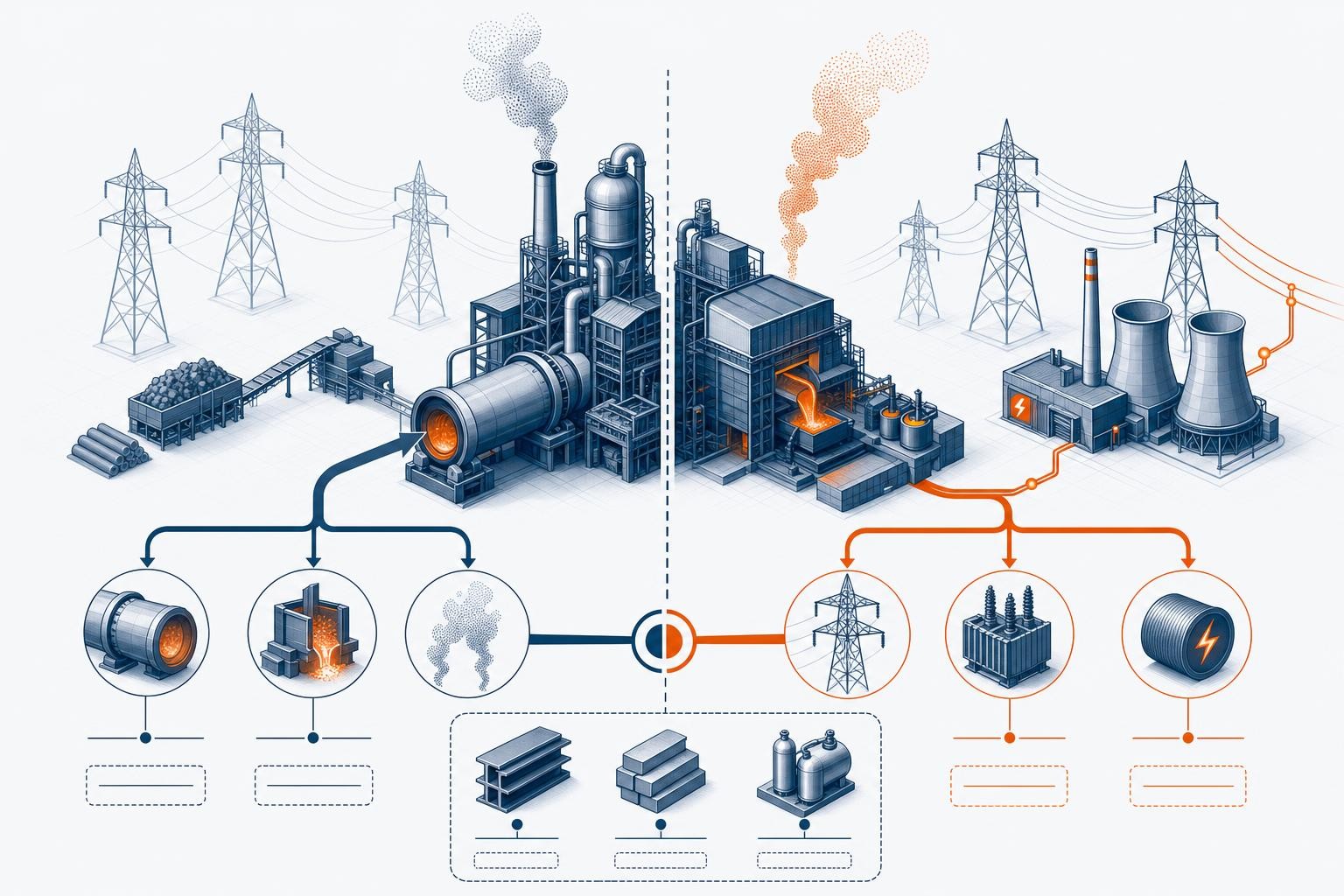
If you import cement or fertilisers, you pay for the electricity your supplier burned to make them. If you import steel, aluminium, or hydrogen, you do not - at least not yet. That asymmetry is deliberate, it is written into the regulation, and it is almost certainly temporary. Understanding why it exists, how the underlying calculation works, and what a future scope extension would cost is the most underappreciated piece of CBAM mechanics for compliance teams right now.
What CBAM means by "indirect emissions" - and what it does not mean
The CBAM Regulation defines embedded emissions as covering both direct emissions released during production and indirect emissions from the generation of electricity consumed during production processes. That definition is in Article 3 of Regulation (EU) 2023/956 and it is deliberately narrow.
Under CBAM, indirect emissions means only the CO₂ released when generating the electricity consumed at the production installation. Transport to port, packaging, upstream logistics, waste treatment - none of these are in scope. This is a critical distinction for compliance teams who also report under CSRD, because the GHG Protocol's Scope 3 covers all of those categories and more.
The mapping looks like this:
| GHG Protocol category | CBAM treatment |
|---|---|
| Scope 1 - direct process and combustion emissions | Always priced (all six sectors) |
| Scope 2 - electricity consumed at the installation | Priced for cement and fertilisers; reported-only for steel, aluminium, hydrogen |
| Scope 3 - transport, packaging, upstream logistics | Out of scope entirely |
CBAM's indirect emissions are a strict subset of Scope 2, limited to the installation boundary. If your CSRD team hands you a Scope 2 figure for a supplier, check whether it covers only on-site electricity or also district heating, off-site processing, and other purchased energy. For CBAM, you need the installation-level electricity consumption number only.
The Annex II split: why some sectors are exempt
Regulation (EU) 2023/956 lists iron and steel, aluminium, and hydrogen in Annex II. For goods in that list, Article 7(1) states that only direct emissions shall be calculated and taken into account for the financial obligation. Cement and fertilisers are not in Annex II, so both their direct and indirect emissions are priced.
The reason is not arbitrary. The regulation's preamble is explicit: indirect emissions should not initially be taken into account for goods in respect of which financial measures apply in the Union that compensate for indirect emissions costs incurred from greenhouse gas emission costs passed on in electricity prices. Those goods are identified in Annex II.
The financial measures in question are the EU ETS indirect cost compensation schemes. Under Article 10a(6) of the EU ETS Directive, EU Member States may provide state aid to electricity-intensive industries - including aluminium smelters and steel producers - to offset the carbon cost embedded in their electricity bills. The logic is straightforward: if an EU aluminium smelter receives state aid to cover its indirect carbon costs, charging a non-EU aluminium smelter for those same indirect emissions at the border would create an asymmetry. The importer would face a cost that the domestic producer does not net bear.
EU cement producers do not receive state aid compensation for indirect carbon costs, so pricing indirect emissions for cement imports creates no asymmetry with domestic treatment. The same applies to fertilisers. That is why those two sectors sit outside Annex II and their indirect emissions are priced.
The Annex II carve-out is not a concession to steel and aluminium lobbies — it is a mirror of how the EU ETS handles those sectors domestically. The moment indirect cost compensation is phased out for EU producers, the logic for excluding indirect emissions from CBAM for those goods disappears with it.
How indirect emissions are actually calculated
For the sectors where indirect emissions are priced (cement and fertilisers), the calculation follows Annex IV, point 4.3 of the CBAM Regulation, further specified in Commission Implementing Regulation 2025/2547. The formula is:
Indirect embedded emissions = electricity consumed (MWh/t output) × emission factor (tCO₂/MWh)
The emission factor follows a hierarchy:
Default (standard) approach: Country-specific default emission factors for electricity are defined in Annex II of Implementing Regulation 2025/2621, calculated as the five-year average of the country-of-origin grid emission factor, based on IEA data. This is the fallback when no better data is available.
Actual approach: A lower emission factor may be used if the installation has a direct technical link to a specific generation source (for example, a dedicated power line from a hydro plant on the same site), or if it holds a qualifying power purchase agreement (PPA) with a renewable electricity producer for an equivalent volume of electricity. In either case, the actual emission factor of that source applies rather than the national grid average.
The practical difference between these two routes can be large. A cement plant in a coal-heavy grid country using the default factor will carry a much higher indirect emissions figure than one with a verified renewable PPA - even if both plants consume identical amounts of electricity per tonne of clinker.
Worked example 1: Integrated cement plant (Turkey)
A Turkish Portland cement plant consumes approximately 110 kWh of electricity per tonne of clinker. Turkey's default grid emission factor under IR 2025/2621 is approximately 0.55 tCO₂/MWh.
- Indirect emissions = 0.110 MWh/t × 0.55 tCO₂/MWh = ~0.060 tCO₂/t clinker
- Direct emissions (calcination + fuel combustion) ≈ 0.83 tCO₂/t clinker
- Indirect share: roughly 7% of total embedded emissions
For cement, indirect emissions are real but modest relative to the chemically unavoidable calcination emissions. The bigger lever for a cement importer is the direct emissions figure.
Worked example 2: Secondary aluminium producer (hypothetical, for illustration)
A secondary (recycled) aluminium smelter in a gas-heavy grid country consumes approximately 700 kWh of electricity per tonne of output. Grid emission factor: 0.45 tCO₂/MWh.
- Indirect emissions = 0.700 MWh/t × 0.45 tCO₂/MWh = ~0.315 tCO₂/t aluminium
- Direct emissions (melting, alloying) ≈ 0.3-0.5 tCO₂/t aluminium
- Indirect share: roughly 40-50% of total embedded emissions
This figure is currently not charged under CBAM because aluminium is in Annex II. But it must still be determined and reported - and the magnitude shows why a scope extension would be material.
Report-only obligations: why Annex II importers still need the data
Steel, aluminium, and hydrogen importers are not charged for indirect emissions today. They are, however, required to report them. Article 7(1) of the CBAM Regulation states that for Annex II goods, only direct emissions shall be taken into account - but the transitional period implementing regulation made clear that reporting of indirect emissions during the transitional period should be open and designed to include methods which lead to similar coverage and accuracy of emissions data in third countries.
In the definitive phase, the CBAM declaration for steel, aluminium, and hydrogen must include indirect emissions data even though no certificates are surrendered for it. The Commission needs this data to calibrate any future scope extension and to verify that the Annex II carve-out remains appropriate.
For importers, this means your supplier data requests cannot stop at direct emissions. You need:
- Electricity consumed per tonne of output at the installation (MWh/t)
- The emission factor applied - grid default or actual (with supporting evidence for the latter)
- Whether the installation has a direct technical link to a specific generator or a qualifying PPA
If your supplier cannot provide these figures, you will need to fall back on country-level defaults for reporting purposes. That is acceptable for now, but it creates a data gap that will become a financial gap if indirect emissions are ever priced.
Why this could change - and what it would cost
The Annex II carve-out was always described as provisional. Recital 19 of the CBAM Regulation states explicitly that future revisions of the EU ETS, in particular revisions of the compensation measures for indirect costs, should be appropriately reflected as regards the scope of application of the CBAM.
The Commission's December 2025 Review Report (COM(2025) 783) sets out a two-step approach for CBAM's evolution. Step 1, covering 2026-2027, focuses on downstream product extension and anti-circumvention. Step 2, planned for 2027, provides for an evaluation of ways to extend the scope to indirect emissions from further CBAM goods - specifically iron and steel, aluminium, and hydrogen.
In June 2026, the Commission's Taxation and Customs directorate published a dedicated Technical Study on Indirect Emissions in the CBAM, examining how to determine default emission factors for indirect emissions, the conditions for claiming actual indirect emissions, and whether and how indirect emissions coverage could be extended to additional CBAM sectors. This is active policy work, not a distant aspiration.
What a scope extension would mean for aluminium
The financial stakes are highest for primary aluminium. Aluminium smelting is an electricity-intensive process: an aluminium smelter needs to consume approximately 14 MWh of electricity to produce one tonne of aluminium. At a grid emission factor of 0.63 tCO₂/MWh - the figure used in EU ETS indirect cost compensation guidelines for 2021-2025 - that translates to roughly 8.8 tCO₂ of indirect emissions per tonne of primary aluminium.
Compare that to the direct emissions currently charged: for a smelter in the UAE or Bahrain powered by natural gas, direct process emissions are approximately 1.5-2.1 tCO₂/t. A smelter in the UAE or Bahrain powered by natural gas carries 7-9 tCO₂e per tonne in total but currently faces CBAM on only approximately 1.5-2.1 tCO₂e per tonne in direct emissions.
At an ETS price of €80/t and the 2026 CBAM factor of 2.5%, the current net CBAM cost on direct emissions alone is modest. If indirect emissions were added at the same factor, the gross exposure would increase by a factor of four to five for coal-powered smelters. By 2034, when the CBAM factor reaches 100%, the difference between a direct-only and a direct-plus-indirect obligation would be measured in hundreds of euros per tonne.
What is enacted versus under review: The Annex II carve-out is current law. No legislative proposal to extend indirect emissions pricing to steel, aluminium, or hydrogen has been tabled as of August 2026. The Commission's Step 2 review is expected to produce a report in 2027; any legislative change would follow the ordinary EU legislative procedure and would not take effect immediately. Plan for the risk, but do not treat it as imminent.
Practical actions for compliance teams
The gap between current law and likely future law creates a clear to-do list.
1. Expand your supplier data template now. Add fields for electricity consumed per tonne of output (MWh/t), the emission factor used (tCO₂/MWh), and the basis for that factor (national grid default, direct technical link, or PPA). Even if you import only steel or aluminium, you want this data on file before it becomes mandatory.
2. Document the emission factor evidence. If a supplier claims a lower-than-grid emission factor on the basis of a PPA or direct line, ask for the PPA contract reference, the volume covered, and the generation source's own emission factor. The CBAM verification standard requires that actual indirect emission factors be substantiated - a supplier assertion alone will not suffice.
3. Assess your supplier's electricity sourcing. A supplier with a renewable PPA covering its full electricity consumption can legitimately claim a near-zero indirect emission factor. For cement and fertiliser importers, this directly reduces your current CBAM certificate obligation. For steel and aluminium importers, it reduces your future exposure if the scope extends. Sourcing decisions upstream at the plant level are the most powerful lever available.
4. Store the data in a format that can be audited. The CBAM declaration for 2026 (due September 2027) will require verified embedded emissions. Indirect emissions data for Annex II goods is not verified in the same way as direct emissions today, but the evidentiary standard will tighten if pricing is extended. Treat the data you collect now as pre-verification evidence.
5. Model the scope-extension scenario. Run the numbers for your top aluminium and steel suppliers using their actual electricity consumption and grid emission factors. The result is your contingent indirect emissions liability. It will focus attention on which supplier relationships are worth investing in for better data - or cleaner electricity.
The bottom line
CBAM's treatment of indirect emissions is not a loophole or an oversight. It is a deliberate mirror of how the EU ETS handles electricity-intensive industries domestically, and it is explicitly flagged in the regulation as provisional. The Commission is actively studying how to extend indirect emissions pricing to steel, aluminium, and hydrogen, with a formal review due in 2027.
For importers of those goods, the practical implication is clear: collect the indirect emissions data now, even though you are not yet paying for it. The cost of building that data pipeline is small. The cost of not having it - when the scope extends and your declaration suddenly needs verified indirect emissions figures - is not.
For cement and fertiliser importers, the mechanics described here are already live. The emission factor hierarchy, the PPA route to lower factors, and the installation-level boundary all apply to your current certificate obligation. Understanding them precisely is the difference between an accurate declaration and one that defaults to punitive country averages.
The indirect emissions question is where CBAM's environmental ambition and its legal architecture are most visibly in tension. That tension will resolve - the only question is when.
Regulation (EU) 2023/956 (the CBAM Regulation), Annex II, Article 7, and Annex IV are the primary legal references for the rules described here. Commission Implementing Regulation 2025/2621 sets the default emission factors for indirect emissions. The Commission's Review Report COM(2025) 783 and the June 2026 Technical Study on Indirect Emissions in the CBAM are the key forward-looking policy documents. For sector-specific calculation guides covering direct emissions, see our dedicated posts on steel, aluminium, cement, and fertilisers.
Related reading
Who Can Actually Accredit Your Supplier's Verifier? Reading the Commission's CBAM Accreditation State-of-Play
The Commission's 25 September accreditation update shows 24 national bodies on board, 15 ready and only 5 taking third-country applications. What that means for suppliers outside the EU and the importers who depend on them.
Norway and Iceland Are Joining CBAM: What the EEA Joint Committee Decisions Change for Importers
On 25 September 2026 the EEA Joint Committee adopted two decisions bringing CBAM to Norway and Iceland. Adoption is not entry into force, though. Here is what is decided, what is pending, and what to watch.
The EU-India Trade Deal Didn't Buy India a CBAM Exemption: What Steel and Aluminium Importers Should Plan For
The EU-India trade agreement cuts tariffs on most goods, but it leaves CBAM untouched. Here is what that means for importers of Indian steel and aluminium, and what to do before the 2026 declaration.