CBAM and Fertilisers: A Plain-English Guide for Importers
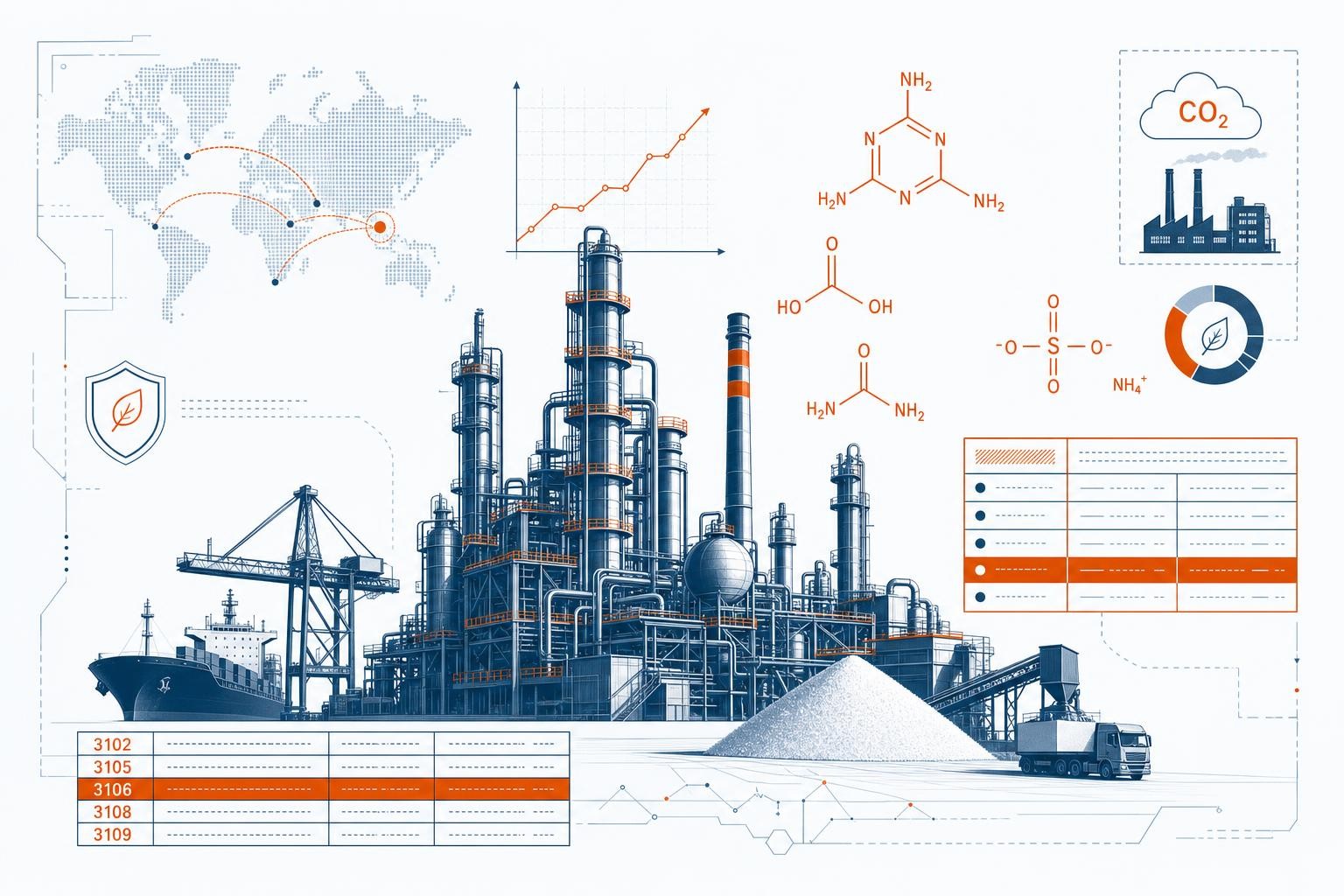
Fertilisers sit at the intersection of chemistry, food security, and climate policy - and from 1 January 2026, they sit squarely inside the EU's Carbon Border Adjustment Mechanism. If you import ammonia, urea, nitric acid, or compound nitrogen fertilisers into the EU, you are now in the definitive phase: certificates must be purchased and surrendered, not just reported.
This guide covers what is in scope, why the emissions accounting is more complex than it looks, what the new default values mean for your costs, and what to do first.
What's in scope: products and CN codes
Fertilisers are one of CBAM's six covered sectors. The goods in scope fall mainly under CN chapters 28 and 31 and include:
| Product | Key CN codes |
|---|---|
| Ammonia (anhydrous or aqueous) | 2814 |
| Nitric acid; sulphonitric acids | 2808 00 00 |
| Urea (whether or not in aqueous solution) | 3102 10 |
| Ammonium nitrate (solid and in solution) | 3102 30, 3102 40 |
| Ammonium sulphate | 3102 21 |
| Mixed nitrogen fertilisers (NPK, NP, etc.) | 3105 (most subheadings) |
Pure phosphorus-potassium fertilisers (CN 3105 60 00) are explicitly excluded from CBAM scope. Everything else under heading 3105 - including NPK blends containing nitrogen - is in.
CN codes are the legal trigger for CBAM. The sector label ('fertilisers') is for orientation only — what matters is whether your specific 8-digit CN code appears in Annex I of Regulation (EU) 2023/956. Always verify against the TARIC consultation tool or the official Annex before acting on any list, including this one.
Why the emissions are more complex than they look
Most CBAM sectors have one benchmark. Fertilisers have two: one for ammonia and one for nitric acid. That matters because almost every nitrogen fertiliser in scope is produced from one or both of these precursors.
Ammonia: the upstream driver
Ammonia is the key precursor. Each tonne of ammonia produced via natural gas releases roughly 1.6-2.0 tonnes of CO₂, and virtually all nitrogen fertilisers - urea, ammonium nitrate, NPK blends - are built on ammonia as their nitrogen source. When you import urea, you are effectively importing the embedded emissions of the ammonia plant that made it.
Nitric acid: where N₂O enters the picture
Nitric acid is produced by the catalytic oxidation of ammonia. Nitrous oxide (N₂O) is released during this process, and N₂O is approximately 300 times more potent as a greenhouse gas than CO₂. CBAM captures these N₂O emissions and converts them to CO₂-equivalent for the embedded-emissions calculation. This is why nitrogen fertilisers - particularly ammonium nitrate and NPK grades that incorporate nitric acid - carry a heavier emissions footprint than a simple carbon-only analysis would suggest.
In practical terms: if you import ammonium nitrate, your CBAM liability reflects both the CO₂ from the ammonia plant and the N₂O from the nitric acid plant. Both direct and indirect emissions (including electricity consumed in production) are counted for fertilisers under CBAM - one of only two sectors, alongside cement, where indirect emissions are included.
Default values vs actual values: what the 2025 regulations say
The Commission published legally binding default values for the definitive period in Implementing Regulation (EU) 2025/2621, published on 31 December 2025 - one day before the definitive phase began.
Default values under IR 2025/2621 are country-specific and represent the average emission intensity of each exporting country, increased by a mark-up. The mark-up is deliberately set to make defaults more expensive than verified actual data, incentivising importers to collect real supplier figures.
For fertilisers specifically, the mark-up is 1% - lower than for steel or aluminium. The fertiliser mark-up was constrained to 1% because of concern that higher defaults would feed directly into food price inflation. Even so, the gap between default and actual values can be substantial in practice.
The benchmark and country default values
The ammonia CBAM benchmark was revised to approximately 1.522 tCO₂e per tonne of ammonia, with the 2.5% CBAM factor applying in 2026 - reducing the effective benchmark to around 1.484 tCO₂e. Country default values for ammonia vary widely:
For urea specifically, Sandbag analysis (February 2026) illustrates the cost difference starkly. An Egyptian urea importer using default values faces a CBAM cost of approximately €42 per tonne of urea at an €80/tCO₂e carbon price; the same importer using verified actual emissions data for an average-efficiency plant would pay around €16 per tonne. For a more efficient plant, the cost falls further to around €7 per tonne. The incentive to collect real data is significant.
Our default values vs actual values guide explains the mechanics in detail. The short version for fertiliser importers: given the complexity of ammonia-urea supply chains, getting actual data from your supplier is harder than in steel or aluminium - but the financial reward for doing so is real.
The 2026 cost context: CBAM meets Russian fertiliser tariffs
CBAM does not arrive in isolation. The EU imposed new tariffs on Russian and Belarusian nitrogen fertilisers from 1 July 2025 - a 6.5% ad valorem duty plus a flat levy of €40-45 per tonne, rising to €430 per tonne by 2028. These tariffs are separate from CBAM and apply regardless of embedded emissions.
In 2023, the EU imported around 3.6 million tonnes of fertiliser from Russia and Belarus, accounting for more than 25% of total EU fertiliser imports by volume. The combined effect of CBAM and the new tariffs has already reshaped trade flows: nitrogen fertiliser imports into the EU fell to 179,877 tonnes in January 2026, down from 1.18 million tonnes in January 2025.
The inflationary picture is more nuanced than some headlines suggest. Sandbag's analysis argues that because EU producers - who set the marginal price - face only a small incremental ETS cost from CBAM (around €1.79 per tonne of urea in 2026), the mechanism is unlikely to drive large price increases on its own. The bigger near-term pressure on EU farmers comes from the Russian tariffs redirecting supply, not from CBAM certificate costs. The Commission has committed to monitoring the fertiliser market and retains powers to act if prices spike.
The CBAM factor in 2026 is only 2.5% — meaning you surrender certificates for just 2.5% of embedded emissions this year. The factor ramps to 5% in 2027, 10% in 2028, and reaches 100% by 2034. Your 2026 exposure is real but modest; the time to build data infrastructure is now, before the factor climbs.
Practical first steps for fertiliser importers
Pull your import declarations and identify every CN code under chapters 28 and 31. Cross-check each against Annex I of Regulation (EU) 2023/956 using the TARIC tool. Then total your annual CBAM goods imports across all six sectors — if the combined mass is below 50 tonnes per legal entity, you are exempt from authorised-declarant status and certificate obligations. See our 50-tonne threshold guide for the detail.
From 1 January 2026, only authorised declarants may import CBAM goods above the threshold. Apply via the CBAM Registry's Authorisation Management Module (you will need an EORI number). Your National Competent Authority has up to 120 days to assess the application — do not wait. See our CBAM Registry guide for the step-by-step process.
Contact your non-EU ammonia, urea, and fertiliser suppliers now. Use the Commission's communication template to request facility-level data covering direct CO₂ and N₂O emissions, electricity consumption, and production volumes. For complex integrated plants (ammonia → urea or ammonia → nitric acid → ammonium nitrate), the data request needs to cover both production stages. The earlier you start, the more time suppliers have to prepare verified data for your September 2027 declaration.
Use your CN codes, country of origin, and import volumes to estimate the cost difference between default and actual values. For most nitrogen fertiliser origins, the gap is large enough to justify the effort of supplier data collection. Factor in the 2.5% CBAM factor for 2026 and budget for the ramp in subsequent years.
CBAM certificates are purchased from your national competent authority at a price tracking the weekly EU ETS auction price. In 2026, prices are set quarterly. Certificates not surrendered by the annual deadline attract a penalty of €100 per tonne of CO₂e — and you still owe the underlying certificates. Build certificate purchasing into your treasury and procurement workflows.
Interactive: estimate your fertiliser CBAM exposure
Use the calculator below to get a rough sense of your 2026 certificate obligation based on product type, origin, and import volume. This is indicative only - always verify against the official default values in IR 2025/2621 and your actual verified data.
The bottom line
Fertilisers are one of CBAM's most technically demanding sectors. Two benchmarks, N₂O emissions from nitric acid production, and complex integrated supply chains mean the emissions accounting requires more care than for a straightforward steel or aluminium import. The good news: the 2.5% factor in 2026 keeps near-term costs manageable, and the fertiliser-specific mark-up on default values is the lowest of any sector. The pressure to act comes not from the 2026 bill but from the ramp ahead - and from the parallel disruption to Russian fertiliser supply that is already reshaping where EU importers source their product.
Get your CN codes mapped, confirm your threshold position, and start the supplier data conversation now. The first annual CBAM declaration for 2026 imports is due by 30 September 2027 - but the data you need to file it accurately is being generated today.
This article is general information, not legal or tax advice. CBAM rules, default values, and CN-code coverage are detailed and subject to change; confirm specifics against the official CBAM legal texts and guidance before acting.
Related reading
Who Can Actually Accredit Your Supplier's Verifier? Reading the Commission's CBAM Accreditation State-of-Play
The Commission's 25 September accreditation update shows 24 national bodies on board, 15 ready and only 5 taking third-country applications. What that means for suppliers outside the EU and the importers who depend on them.
Norway and Iceland Are Joining CBAM: What the EEA Joint Committee Decisions Change for Importers
On 25 September 2026 the EEA Joint Committee adopted two decisions bringing CBAM to Norway and Iceland. Adoption is not entry into force, though. Here is what is decided, what is pending, and what to watch.
The EU-India Trade Deal Didn't Buy India a CBAM Exemption: What Steel and Aluminium Importers Should Plan For
The EU-India trade agreement cuts tariffs on most goods, but it leaves CBAM untouched. Here is what that means for importers of Indian steel and aluminium, and what to do before the 2026 declaration.