CBAM and Electricity Imports: A Plain-English Guide for Cross-Border Power Traders
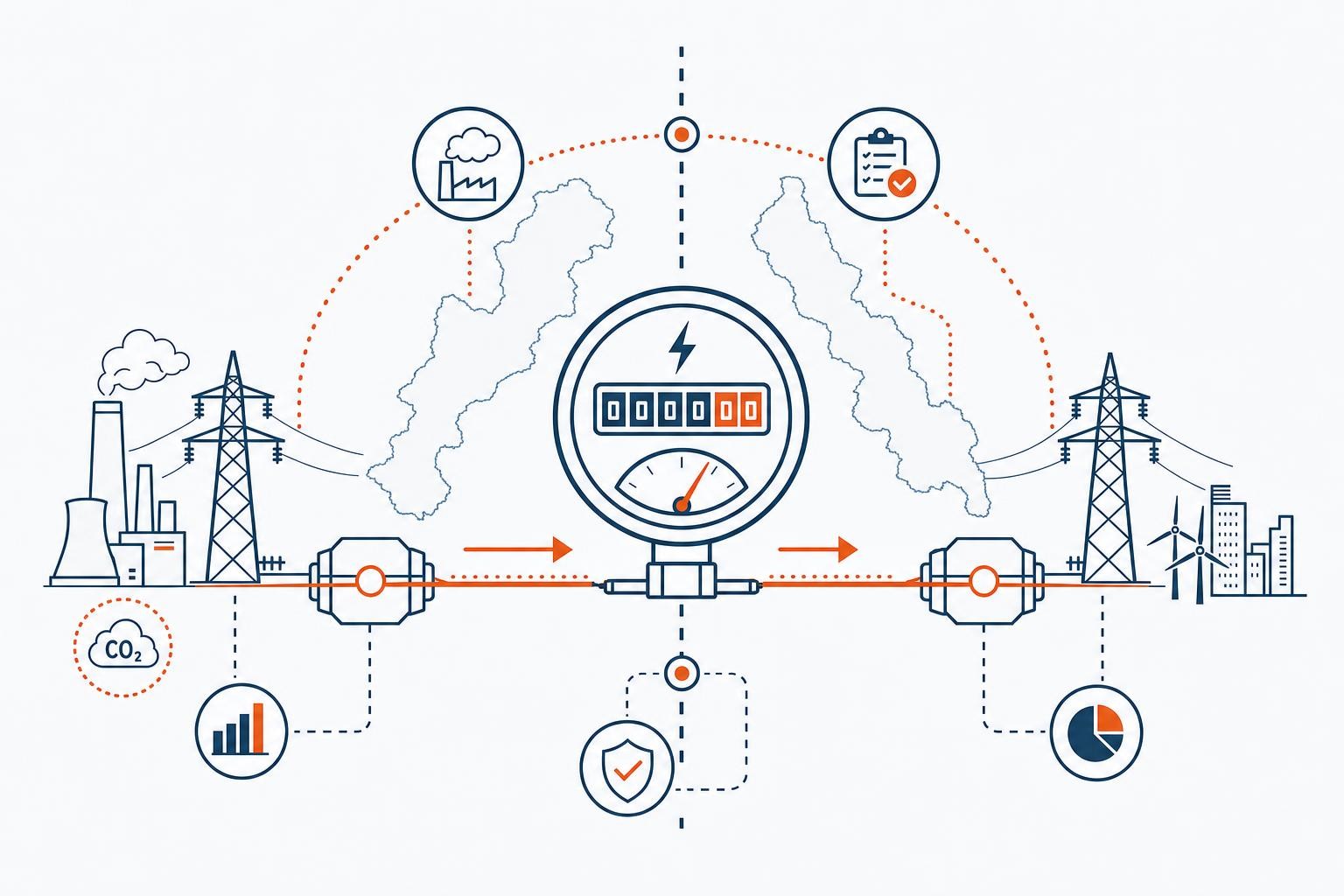
Electricity sits inside CBAM's six covered sectors, but it works differently from steel, aluminium, or cement. The calculation logic is distinct, the small-importer exemption does not apply, and the default values that determine your certificate obligation were published - in final, legally binding form - just one day before the definitive period began.
If you import electricity across EU interconnectors from a non-EU country, this guide is for you.
Why electricity is different from the other five CBAM sectors
Most CBAM goods are physical products: you weigh them, look up the country-of-origin default emission factor per tonne, and multiply. Electricity cannot be weighed. It is measured in megawatt-hours, flows across interconnectors in real time, and its carbon content varies by the hour depending on what is generating at that moment.
The regulation handles this by treating electricity as its own category with three specific rules that set it apart.
1. Direct emissions only - and what that means in practice
Electricity was added to Annex II of the CBAM Regulation, which means only direct emissions are counted for the purposes of calculating embedded emissions. The same is true for steel, aluminium, and hydrogen. By contrast, cement and fertilisers include both direct and indirect emissions (the CO₂ from electricity consumed during production).
For electricity imports, this distinction is straightforward: the embedded emissions figure is simply the carbon intensity of the power itself - expressed as tCO₂e per MWh - multiplied by the volume imported. There is no separate layer of indirect emissions to calculate on top. You are pricing the carbon in the electrons, not the carbon used to make something with those electrons.
2. No 50-tonne de minimis exemption
The 2025 Omnibus simplification introduced a single mass-based threshold: importers bringing fewer than 50 tonnes per year of CBAM goods across all six sectors are exempt from the authorised-declarant requirement and certificate obligations. Electricity and hydrogen are explicitly excluded from this threshold under Article 2(3a) of the amended CBAM Regulation.
That means there is no minimum volume below which electricity imports escape CBAM. A single cross-border delivery - however small - requires you to hold Authorised CBAM Declarant (ACD) status before importing. We have covered the 50-tonne threshold in detail in a separate post; the key point here is that it simply does not apply to power.
3. A single CN code
Electricity falls under a single Combined Nomenclature code: CN 2716 00 00. Unlike steel or aluminium, which span dozens of CN codes with different default values, every electricity import uses the same code. The variable is not the product classification - it is the country of origin.
The Annex III default emission factors
Implementing Regulation (EU) 2025/2621, published in the Official Journal on 31 December 2025 - one day before the definitive period began - sets out the legally binding default emission factors for imported electricity in Annex III.
These are country-specific values expressed in tCO₂e per MWh. They are calculated as a five-year weighted average of each exporting country's CO₂ emission factor for fossil-fuel electricity generation, using International Energy Agency data. The five-year average means the figures reflect a country's recent grid mix, but they lag real-time conditions - a point that has drawn criticism from industry bodies who argue that rapidly decarbonising grids (such as the UK's) are penalised by historical averages.
How the default is applied:
- Identify the country from which the electricity physically enters the EU (the country of origin, not the country of the trading counterparty).
- Look up that country's Annex III default factor (tCO₂e/MWh).
- Multiply by the volume imported (MWh).
- Apply the mark-up for the relevant year (see below).
- Multiply by the prevailing CBAM certificate price (linked to the EU ETS allowance price).
If a country is not listed in Annex III, the "other countries and territories" fallback value applies - typically a conservative figure.
The country of origin is the country where the electricity is generated, not where it is traded or scheduled. If you buy power from a UK trader but it physically flows from a Norwegian generator via the UK grid, the applicable default factor is Norway's — provided you can demonstrate the physical origin. In practice, most interconnector flows use the default of the directly connected exporting country.
The mark-up schedule
Default values are intentionally set above the national average to discourage reliance on them and to account for the possibility that individual generators are dirtier than the country mean. Under IR 2025/2621, the mark-up on electricity default values is 10% in 2026, 20% in 2027, and 30% from 2028 onwards.
This is the same schedule that applies to steel, aluminium, and cement - not the 1% rate that applies to fertilisers. The practical effect is that the cost of using a default rather than a verified actual value grows each year.
The Commission has indicated it intends to review both the default values and the mark-up rates by December 2027 at the latest, with efforts to carry out a revision as early as 2026.
Using actual emission factors instead of defaults
The default-first logic is explicit in the regulation: unless you can demonstrate that specific conditions are met, the Annex III country default applies. There are two routes to using a lower actual emission factor.
Route 1: Direct technical link
If there is a direct physical connection between a specific generating installation and the EU grid - with no network congestion between them - the actual emission factor of that installation can be used. In practice, this means the generator must be able to demonstrate a grid diagram showing the connection and provide metering data confirming that the electricity was delivered within the same hourly period as the import.
Route 2: Qualifying power purchase agreement (PPA)
Where electricity is supplied under a PPA, the actual emission factor of the contracted generation source may be used instead of the grid average. The Commission's rules place physical, hourly delivery at the centre of this approach. A qualifying PPA must:
- Be a physical PPA (not a financial or virtual arrangement)
- Directly link the authorised CBAM declarant to a specific third-country electricity producer
- Cover the relevant volumes and time periods
- Be supported by smart meter data confirming hourly-matched delivery
Energy attribute certificates (such as Guarantees of Origin or I-RECs) do not, on their own, satisfy the CBAM actual-emissions criteria, because most systems are not yet capable of supporting robust hourly tracking.
The bar is deliberately high. Annual or monthly matching is not sufficient. This is a significant operational challenge for most electricity traders, and it means that the majority of cross-border power imports will, in practice, use the Annex III default for the foreseeable future.
Watch this space. The Commission is actively consulting on amendments to the electricity rules following industry feedback that the current framework is overly rigid. A legislative proposal is in progress that would, among other things, clarify PPA rules for intermediaries and refine the conditions for demonstrating a direct technical link. The rules as described here reflect the position from 1 January 2026; check the Commission's CBAM hub for updates.
Who is affected and what determines your liability
The primary affected parties are traders and utilities importing electricity across EU interconnectors from neighbouring non-EU countries. Based on current interconnector geography, the most significant flows come from countries including the UK, Ukraine, Morocco, Serbia, Montenegro, North Macedonia, and other Western Balkans states.
Your CBAM liability for a given import is determined by three variables:
| Variable | What it means in practice |
|---|---|
| Country of origin | Determines which Annex III default factor applies |
| Volume (MWh) | The quantity imported in the calendar year |
| Certificate price | Linked to the EU ETS allowance price at time of purchase |
The CBAM factor - the proportion of free allocation that has been removed - also matters. In 2026, the CBAM factor is only 2.5%, because 97.5% of free allocation remains in force. Note, however, that electricity generation does not receive free allowances under the EU ETS, so the free-allocation adjustment that reduces net costs for steel or cement importers does not apply in the same way to electricity. The CBAM factor for electricity effectively reflects the phase-in schedule of the mechanism itself.
Estimate your 2026 electricity CBAM cost
Practical first steps for electricity importers
If you import any electricity from a non-EU country across an interconnector into the EU, you are in scope — regardless of volume. There is no de minimis threshold for electricity. Check that your counterparty arrangements correctly identify the physical country of origin of the power.
You must hold ACD status before importing. Applications are made through the CBAM Registry's Authorisation Management Module (AMM) via your National Competent Authority. If you have not yet applied, do so immediately — the definitive period has been live since 1 January 2026.
Look up the country of origin in Annex III of IR 2025/2621 (available on EUR-Lex). Note the tCO₂e/MWh figure. Apply the 10% mark-up for 2026 imports. If the country is not listed, use the 'other countries and territories' fallback value.
If you have a physical PPA with a specific generator, review whether it meets the hourly-matching and physical-delivery requirements. If it does, you may be able to use a lower actual emission factor — reducing your certificate obligation. Take legal advice on whether your existing contracts qualify.
CBAM certificates must be purchased from your national authority and surrendered by 30 September 2027 for 2026 imports. You must also hold certificates equal to at least 50% of cumulative embedded emissions at the end of each calendar quarter. Build this into your cash-flow planning now.
The Commission is actively consulting on amendments to the electricity-specific rules, including PPA definitions and actual-emissions criteria. The default values themselves are due for revision by December 2027. Subscribe to regulatory updates so that changes to Annex III or the PPA framework do not catch you off guard.
Key dates and numbers at a glance
| Item | Detail |
|---|---|
| Definitive period start | 1 January 2026 |
| Governing regulation | IR (EU) 2025/2621, published 31 December 2025 |
| Default factors | Annex III - country-specific, tCO₂e/MWh |
| Mark-up 2026 | 10% |
| Mark-up 2027 | 20% |
| Mark-up 2028+ | 30% |
| First declaration deadline | 30 September 2027 (for 2026 imports) |
| 50-tonne exemption | Does not apply to electricity |
| CN code | 2716 00 00 |
| Default value revision | By December 2027 at the latest |
Download the CBAM Readiness Checklist
If you are still working through whether your electricity import arrangements are compliant, our free CBAM Readiness Checklist covers the authorisation steps, certificate obligations, and data requirements across all six sectors - including the electricity-specific rules set out above.
This article is general information, not legal or tax advice. CBAM rules, default values, and implementing acts are detailed and subject to change; confirm specifics against the official legal texts - in particular IR (EU) 2025/2621 and the Commission's CBAM hub at taxation-customs.ec.europa.eu - before acting.
Related reading
CBAM and Indirect Emissions: Why the Annex II Split Matters for Steel, Aluminium, and Hydrogen Importers
CBAM prices indirect emissions for cement and fertilisers but not for steel, aluminium, or hydrogen - and the reason why matters for your compliance strategy. Here's the full mechanics.
Making Your Supply Contract CBAM-Ready: A Clause-by-Clause Drafting Guide
CBAM is now a contracting problem. This clause-by-clause guide covers emissions data, verification, price pass-through, Incoterms, indemnity, and change-in-law for EU importers of steel, aluminium, cement, fertilisers, and hydrogen.
CBAM and Customs Procedures: How Release for Free Circulation Changes Everything
CBAM obligations attach at release for free circulation, not at physical arrival. That single fact makes your choice of customs procedure a genuine compliance and cash-flow lever. Here's the practical guide.