CBAM Default Values vs Actual Values: Which Should You Use?
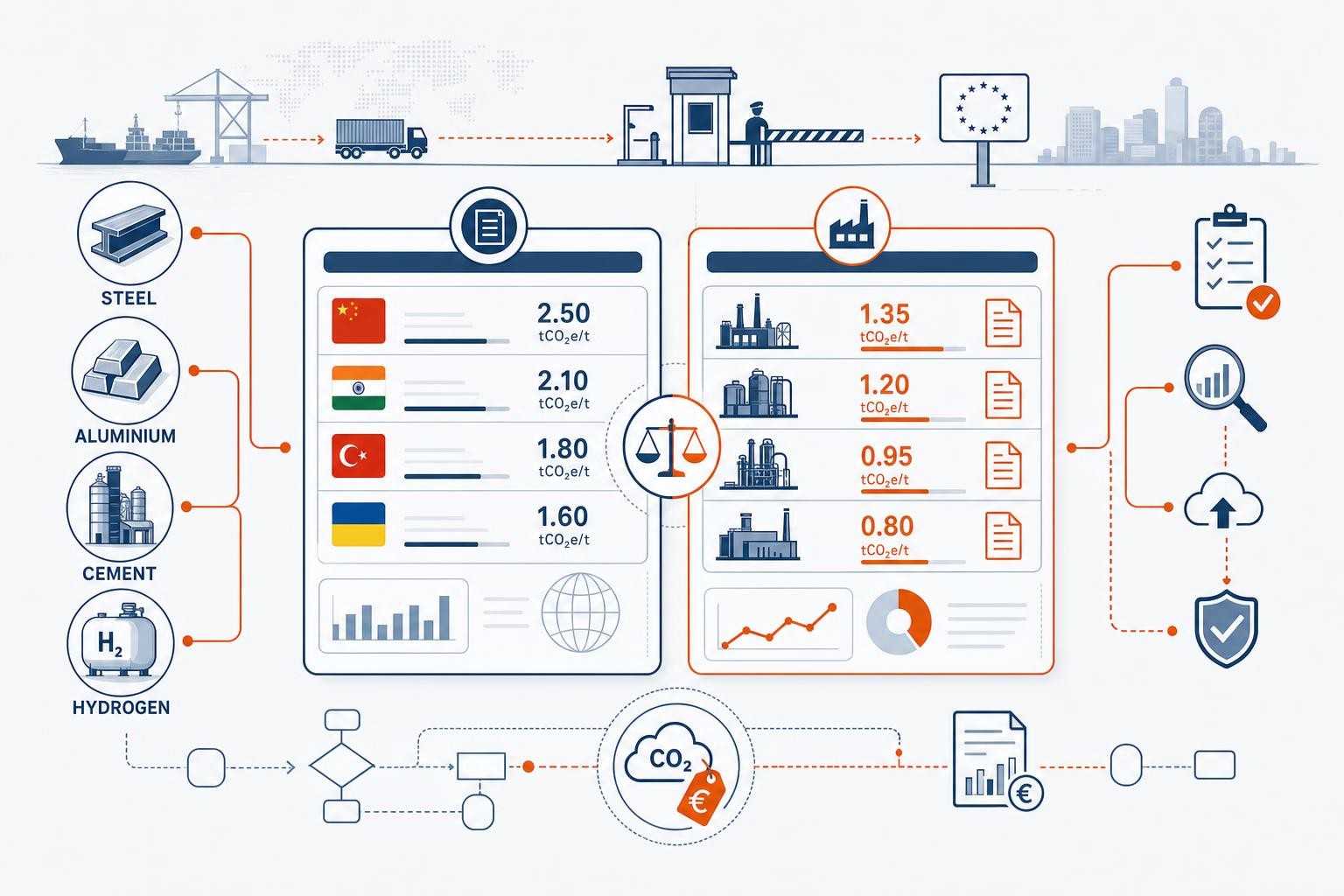
Every EU importer of CBAM goods faces the same early decision: report your embedded emissions using the Commission's published default values, or go to the effort of collecting actual, installation-specific data from your supplier. Neither answer is wrong - but the cost difference between them is growing, and it will keep growing until at least 2028.
This guide explains the trade-offs in plain English so your sustainability or finance team can make an informed call.
The two routes, briefly
Default values are country- and product-specific emission intensities published by the European Commission. They are set out in Commission Implementing Regulation (EU) 2025/2621 (16 December 2025), with an accompanying Excel file released in February 2026. The legally binding values are set out in IR (EU) 2025/2621, while the Excel file is made available for information purposes only. You look up the figure for your good and country of origin, multiply by the tonnes imported, and you have your declared embedded emissions. No supplier data required.
Actual values are installation-specific figures - real monitoring data from the factory that made your goods. To use actual values, EU importers depend entirely on data from non-EU installation operators; for imports in 2026, the full calendar year needs to be covered, and producers must collect data according to a monitoring plan, report it to accredited verifiers, and obtain a compliant verification report.
The mark-up: why defaults cost more over time
Default values are not neutral estimates. They are determined using a conservative approach that ensures embedded emissions are not underestimated when applying default values. On top of that baseline conservatism, the regulation adds an explicit mark-up to incentivise importers to move to actual data.
For steel, aluminium, and cement, the mark-up on default values is 10% in 2026, rising to 20% in 2027 and 30% from 2028 onwards. The mark-up is 10% for 2026, 20% for 2027, and 30% for 2028 and beyond.
Fertilisers are treated differently. For aluminium, cement, and iron & steel the mark-up increases from 10% in 2026 to 30% in 2028; due to the difficulty of obtaining actual data across complex chemical supply chains, it is set at only 1% for fertiliser.
The fertiliser sector mark-up is just 1%, reflecting the complexity of obtaining actual data across chemical supply chains.
⚠️ Confirm these figures against IR (EU) 2025/2621 and IR (EU) 2025/2620 (the XLS released February 2026) before using them in financial modelling. The Commission has indicated it will review both the default values and mark-up rates by December 2027 at the latest.
The practical effect: importers using default emission values pay 10-30% more than those with verified actual data. For a high-volume steel importer, that premium can be substantial.
Verification: only required for actual values
This is the most important simplification in the post-Omnibus rules.
Verification is applicable only to actual emissions data. Therefore, verification does not apply to the use of default values. If you rely entirely on defaults, you do not need an accredited verifier - full stop.
If you do use actual values, the rules are strict. CBAM declarants will only be permitted to report actual emissions data from their non-EU suppliers if it has been verified by an accredited verifier. One of the most significant requirements is the mandatory physical site visit at every installation producing CBAM goods - at least for the first reporting period. From 2027, virtual visits or waivers become possible for low-risk installations.
Importers using only default values are not subject to third-party verification under the CBAM definitive-phase rules.
Direct and indirect emissions: what counts
Regardless of which route you choose, you need to understand what you are declaring.
Direct emissions (released during production) count for all CBAM goods - steel, aluminium, cement, fertilisers, hydrogen, and electricity.
Indirect emissions (from electricity consumed in production) count for cement and fertilisers only. The standard approach for indirect emissions is to use default values for the emission factor of electricity consumed in the production process; country-specific default values for these emission factors are defined in Annex II of IR 2025/2621, calculated based on the average emission factor of the country-of-origin electricity grid for the most recent five-year period for which reliable data is available.
The carbon-price-paid-abroad deduction
One further variable: if your supplier's country already charges a carbon price on the goods you import, you may be able to deduct that cost from your CBAM certificate obligation. If importers can prove that a carbon price has already been paid during the production of the imported goods, the corresponding amount can be deducted. The detailed rules for calculating and evidencing this deduction are still being finalised in a separate implementing act - worth watching if you source from the UK, South Korea, or other jurisdictions with active carbon pricing.
Side-by-side: default vs actual
| Default values | Actual values | |
|---|---|---|
| Data source | Commission-published tables (IR 2025/2621 + XLS) | Installation-specific monitoring data from your supplier |
| Mark-up (steel/aluminium/cement) | 10% in 2026 → 30% from 2028 (⚠️ confirm vs IR 2025/2621) | None — you pay for real emissions only |
| Mark-up (fertilisers) | 1% (⚠️ confirm vs IR 2025/2621) | None |
| Verification required? | No | Yes — accredited third-party verifier + site visit |
| Supplier data needed? | No | Yes — full-year monitoring plan and report |
| Typical cost | Higher certificate cost due to conservative values + mark-up | Lower certificate cost, but verifier fees and supplier engagement time |
| Admin effort | Low — look up the table, apply the figure | High — supplier outreach, monitoring plan, verification process |
| Best for | Small/occasional importers; early-stage compliance | High-volume importers where certificate savings outweigh verification costs |
When to use which: a practical steer
The right choice depends on your import volumes, your supplier relationships, and how much time you have.
Lean towards default values if:
- Your annual CBAM imports are modest in value or tonnage.
- You have limited visibility into your supplier's production processes.
- You are in the first year of compliance and need to file a declaration quickly.
- Your goods are fertilisers - the 1% mark-up makes the cost penalty minimal.
Lean towards actual values if:
- You import large volumes of steel, aluminium, or cement, where the 10-30% mark-up translates into a meaningful certificate cost.
- Your supplier already has a monitoring plan in place or is willing to build one.
- Your supplier's facility is demonstrably cleaner than the country average - in which case actual values will be lower than the default, not just by the mark-up but by the underlying emission intensity difference.
- You want to build a defensible, audit-ready compliance position for the long term.
You are not locked into one approach for all your goods. You can use actual values for your highest-volume product lines — where the saving justifies the verifier cost — and default values for smaller or more complex supply chains. A mixed approach is entirely permitted.
The decision tree: which route is right for you?
What to do next
- Look up the default values for your goods and country of origin: Default Values Reference
- Understand the verification process before committing to actual values: Verification Guide
- Model the cost difference using our certificate calculator: CBAM Cost Calculator
- Get your supplier ready with our data templates: Supplier Data Templates
The first CBAM declaration for 2026 imports is due by 30 September 2027. That sounds distant, but if you are going the actual-values route, your supplier needs to be collecting monitoring data now - for the full calendar year 2026. The time to decide is not next year.
Want a fortnightly digest of CBAM rule changes, certificate prices, and compliance deadlines? Subscribe to The CBAM Brief - free, no spam.
Sources: Commission Implementing Regulation (EU) 2025/2621 (EUR-Lex); Commission Implementing Regulation (EU) 2025/2620 (EUR-Lex); DG TAXUD CBAM legislation and guidance page; ICAP Carbon Action Partnership CBAM compliance phase summary.
Related reading
CBAM Monitoring Plans: What Installation-Level Data Quality Actually Requires
The monitoring plan - not just the final emissions number - is now the primary object of CBAM scrutiny. Here's what IR 2025/2547 requires at the installation level, and why traceability is the recurring failure point.
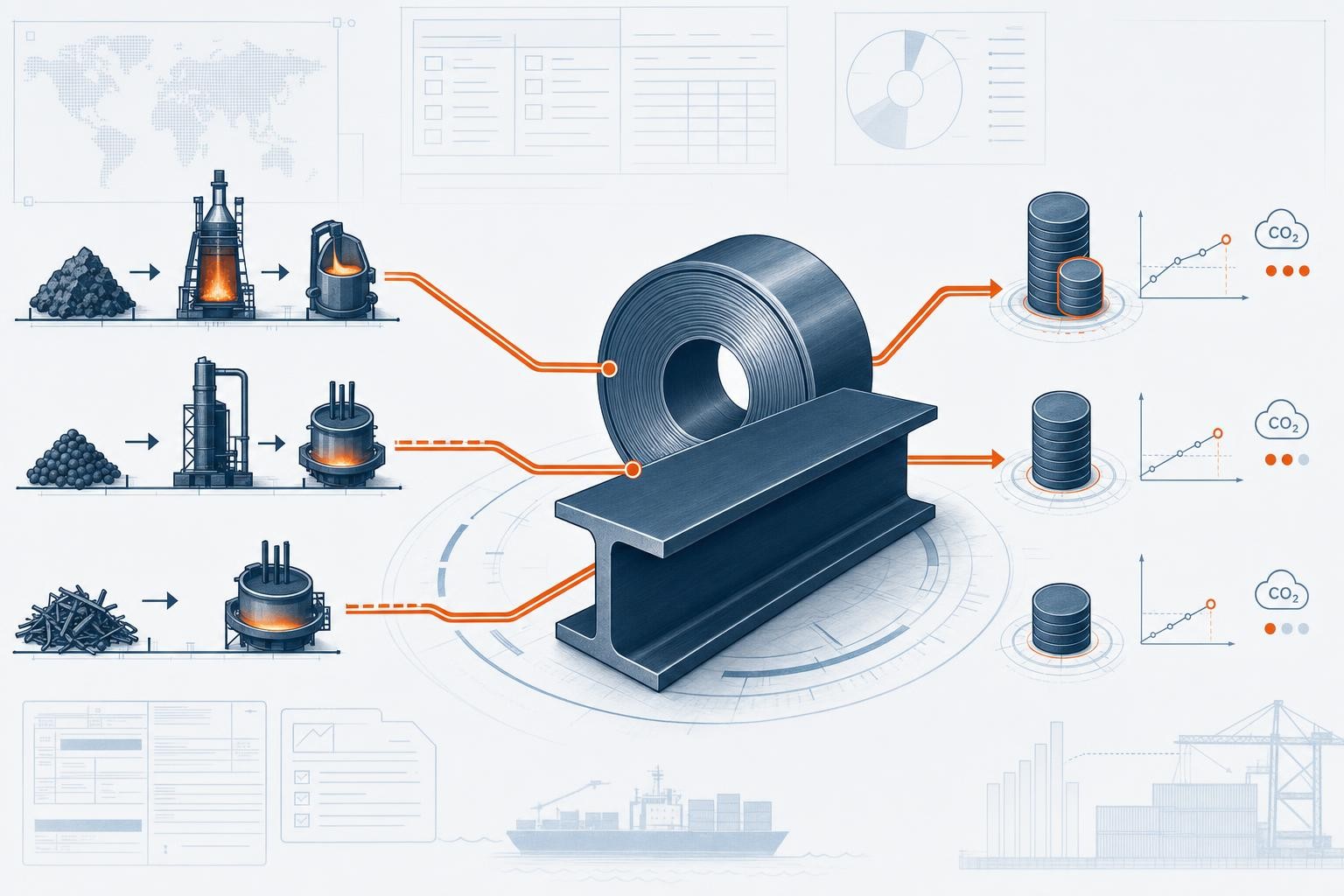
CBAM and Steel: Why Your Supplier's Production Route Is Now a Procurement Decision
Steel's CBAM cost isn't fixed - it swings by up to 19x depending on how your supplier makes steel. Here's how the BF-BOF, DRI-EAF, and Scrap-EAF benchmarks translate into real sourcing decisions.
Becoming an Authorised CBAM Declarant: A Practical Guide for EU Importers
The 31 March 2026 deadline has passed. Here's what Authorised CBAM Declarant status means, what the transitional easement covers, how financial guarantees work, and what every importer must do before September 2027.