How to File Your First Annual CBAM Declaration: A Step-by-Step Guide for EU Importers
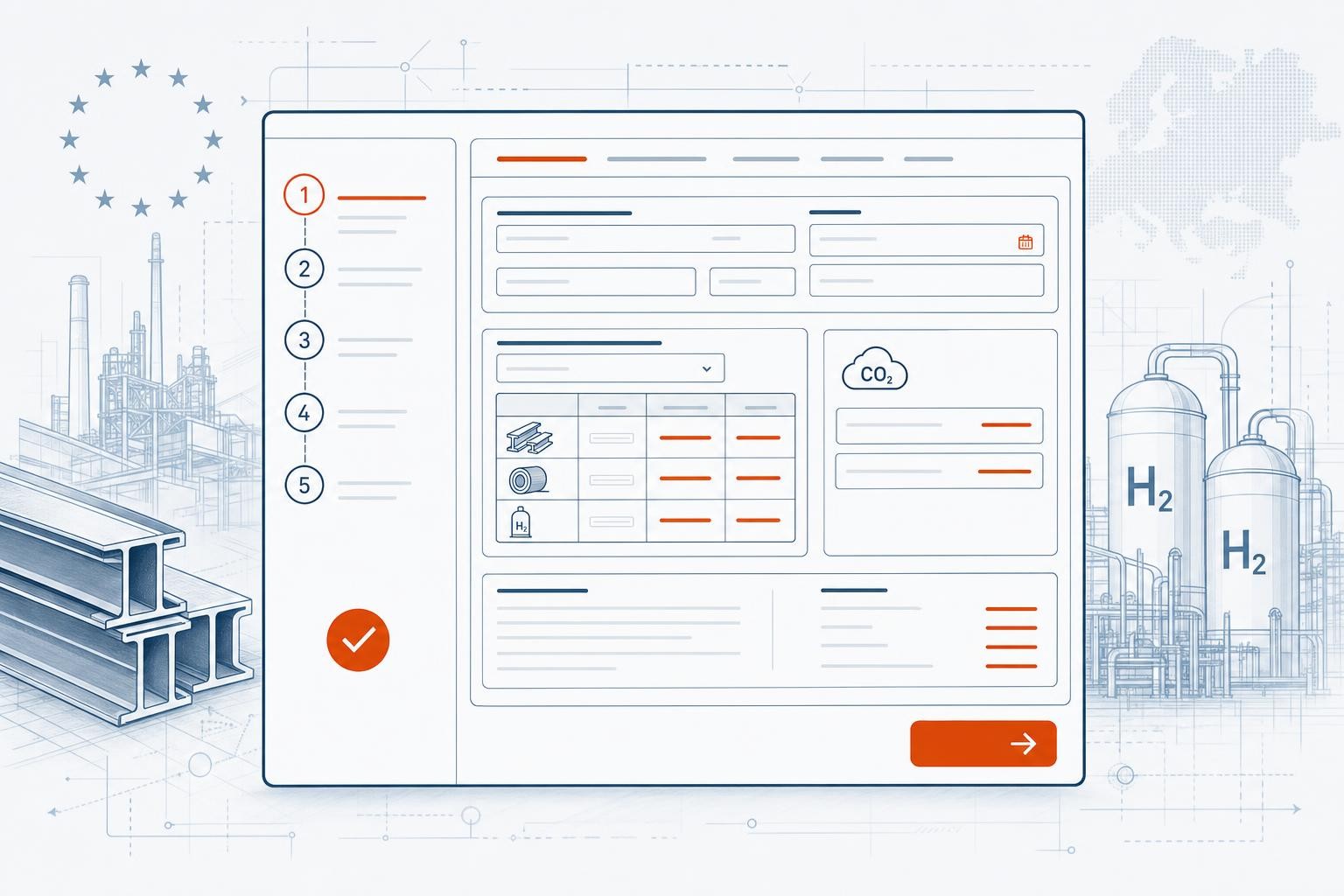
The quarterly CBAM reports are gone. From 2026 onwards, the obligation is a single annual declaration - one filing per year, covering every tonne of CBAM-covered goods you imported in the prior calendar year. The first one lands on 30 September 2027, and the data you are generating right now, in 2026, is what fills it.
This post walks through the filing process itself: what the declaration contains, who is legally entitled to submit it, what data you need to assemble during 2026, how embedded emissions are calculated, and what the verification requirement means in practice. For the mechanics of buying and surrendering certificates, or the penalty regime, see our dedicated posts on those topics.
What the annual CBAM declaration actually is
The first annual CBAM declaration covers calendar year 2026 imports and must be submitted by 30 September 2027. That deadline was moved from the originally proposed 31 May under the Omnibus simplification package (Regulation (EU) 2025/2083, which entered into force on 20 October 2025). Every year thereafter, the pattern repeats: 30 September is the permanent annual deadline, each filing covering the prior calendar year.
The declaration is submitted through the CBAM Registry - specifically the declaration module within the Declarant Portal. It states, for each category of CBAM goods you imported:
- The total quantity of goods (in tonnes, by CN code and country of origin)
- The total embedded emissions (in tonnes of CO₂e) associated with those imports
- The number of CBAM certificates to be surrendered against those emissions
- Any carbon price already paid in the country of origin that you are claiming as a deduction
- The verification report (if you are using actual emissions values - more on this below)
The Commission reviews declarations, and your National Competent Authority (NCA) can follow up with queries or initiate penalty proceedings if the filing is incomplete or inaccurate.
Who may file: the authorised declarant requirement
Not everyone can submit a CBAM declaration. From 1 January 2026, only an authorised CBAM declarant may import CBAM goods above the 50-tonne annual threshold. If you are not authorised, your goods will be refused customs clearance - there is no grace period for the declaration itself.
Two categories of entity can hold authorised declarant status:
- EU-established importers - any company established in an EU Member State that imports CBAM goods above the threshold applies in its own name.
- Indirect customs representatives - where the importer is not established in the EU, the indirect customs representative must obtain authorised declarant status regardless of import volume; there is no 50-tonne exemption for this category.
The application goes through the CBAM Registry's Authorisation Management Module (AMM), addressed to the NCA of your Member State of establishment. NCAs have up to 120 days to decide. The key eligibility criteria include: establishment in the Member State where you apply; a valid EORI number; proof of financial and operational capacity to meet CBAM obligations; and - critically - no serious or repeated infringement of customs, tax, or market abuse rules in the five years prior to the application.
Authorised declarant status is recognised across all Member States once granted. If you have not yet applied, do so immediately - the 120-day assessment window means late applications create real import-disruption risk.
The data you need to assemble during 2026
The declaration is only as good as the records behind it. Every import you make in 2026 needs to be tracked at the installation level - not just by supplier or country, but by the specific production facility that made the goods. Here is what to capture for each shipment:
- CN code and net mass (tonnes) of goods imported
- Country of origin and the specific non-EU production installation
- Embedded emissions figure (either actual or default - see below) expressed in tCO₂e per tonne of goods
- Customs declaration reference for each import entry
- Carbon price paid in the country of origin, if any, with supporting documentation
Linking every import entry number to its embedded-emissions figure in a single auditable record - a spreadsheet or compliance system - is the single most practical thing you can do in 2026. Errors in CN codes between customs declarations and CBAM filings can invalidate the declaration entirely.
Actual values vs. default values: the choice that drives your cost
When calculating embedded emissions, you have two routes.
Actual values are the verified, installation-specific emissions figures provided by your non-EU manufacturer. They reflect what that facility genuinely emitted per tonne of output. For efficient, modern producers, actual values are almost always lower than defaults - sometimes substantially so.
Default values are published by the Commission in Implementing Regulation (EU) 2025/2621, set at the average emission intensity of each exporting country for each CBAM good. They come with a deliberate mark-up to discourage reliance on them: the mark-up is 10% in 2026, rising to 20% in 2027 and 30% from 2028 onwards - except for fertilisers, where the mark-up is capped at 1% annually. For steel, aluminium, and cement importers sourcing from carbon-intensive origins, the gap between a default-value bill and an actual-value bill can be very large. Our dedicated post on default vs. actual values works through the numbers in detail.
The critical procedural difference: verification is only required when you use actual values. If you rely entirely on Commission defaults, no accredited verifier is needed. That simplification is real - but so is the cost premium you pay for it.
The verification requirement
For the first annual declaration (covering 2026 imports), embedded emissions based on actual values must be verified by an accredited third-party verifier before the 30 September 2027 deadline. The European Commission's CBAM verification page confirms that verification must be carried out by independent verifiers accredited by EU national accreditation bodies under EN ISO/IEC 14065.
The verification process works at the production installation level, not at the importer level. Your non-EU supplier monitors and calculates emissions at their facility, a CBAM-accredited verifier conducts a physical site visit and issues a verification report, and that report is uploaded to the CBAM Registry and attached to your declaration.
Two practical constraints matter here:
- Verifier registration in the CBAM Registry opens 1 September 2026, leaving roughly 13 months for accredited firms to conduct site visits across thousands of non-EU facilities globally before the declaration deadline.
- The first verification period requires a mandatory physical site visit - video inspection is not a permitted substitute under the applicable delegated regulation.
Demand for accredited verifiers will concentrate heavily in Q4 2026 and Q1 2027. If you intend to use actual values, begin identifying and engaging a verifier now, before the registration window even opens.
Key dates at a glance
| Date | What happens |
|---|---|
| 1 January 2026 | Definitive period begins; only authorised declarants may import CBAM goods above threshold |
| Throughout 2026 | Collect installation-level emissions data for every import |
| 1 September 2026 | Verifier registration opens in CBAM Registry |
| 31 December 2026 | End of the 2026 import year - the period your first declaration covers |
| 1 February 2027 | Certificate sales open on the EU central platform |
| 30 September 2027 | First annual declaration due; certificates surrendered |
| 1 November 2027 | Unused 2026 certificates cancelled without compensation |
| 30 September 2028 | Second annual declaration due (covering 2027 imports) |
Your 2026 preparation checklist
The declaration is filed in 2027, but the work happens in 2026. Here is what to do before the year is out:
If you have not yet been granted status, apply immediately via the CBAM Registry's Authorisation Management Module. The NCA has up to 120 days to decide. Do not wait.
For each CBAM goods shipment, record the CN code, net mass, country of origin, and the specific non-EU installation that produced the goods. Link this to the customs declaration reference.
Ask each non-EU manufacturer whether they can provide actual embedded emissions data for 2026 under the CBAM methodology (IR 2025/2547). If they cannot, you will use default values — and pay the mark-up.
For suppliers who can provide actual data, identify an accredited verifier now. Verifier capacity is genuinely constrained; engaging early is not optional if you want actual values in your declaration.
Maintain a single, auditable log linking every import entry to its embedded-emissions figure, CN code, and installation. This is what your compliance team — or a delegated third party — will use to populate the declaration.
No cash payment is due in 2026, but the liability accrues from 1 January 2026. Factor estimated CBAM certificate costs into your 2026 accounts and budget. Certificate sales open 1 February 2027.
The bottom line
The 30 September 2027 deadline is fixed, but the data behind the declaration is being created right now, with every shipment you clear through customs in 2026. The importers who will file cleanly and cost-efficiently are the ones who start collecting installation-level emissions data from their suppliers today - not in January 2027 when the clock is running.
If your suppliers cannot yet provide actual emissions data, default values are a lawful fallback. But the mark-up is real, it grows every year, and it is deliberately designed to make actual values the more attractive option over time.
This post is an independent plain-English explainer. It is not legal or compliance advice. Always refer to the official European Commission CBAM pages and the legal texts - Regulation (EU) 2023/956 as amended by Regulation (EU) 2025/2083 - before acting.
Related reading
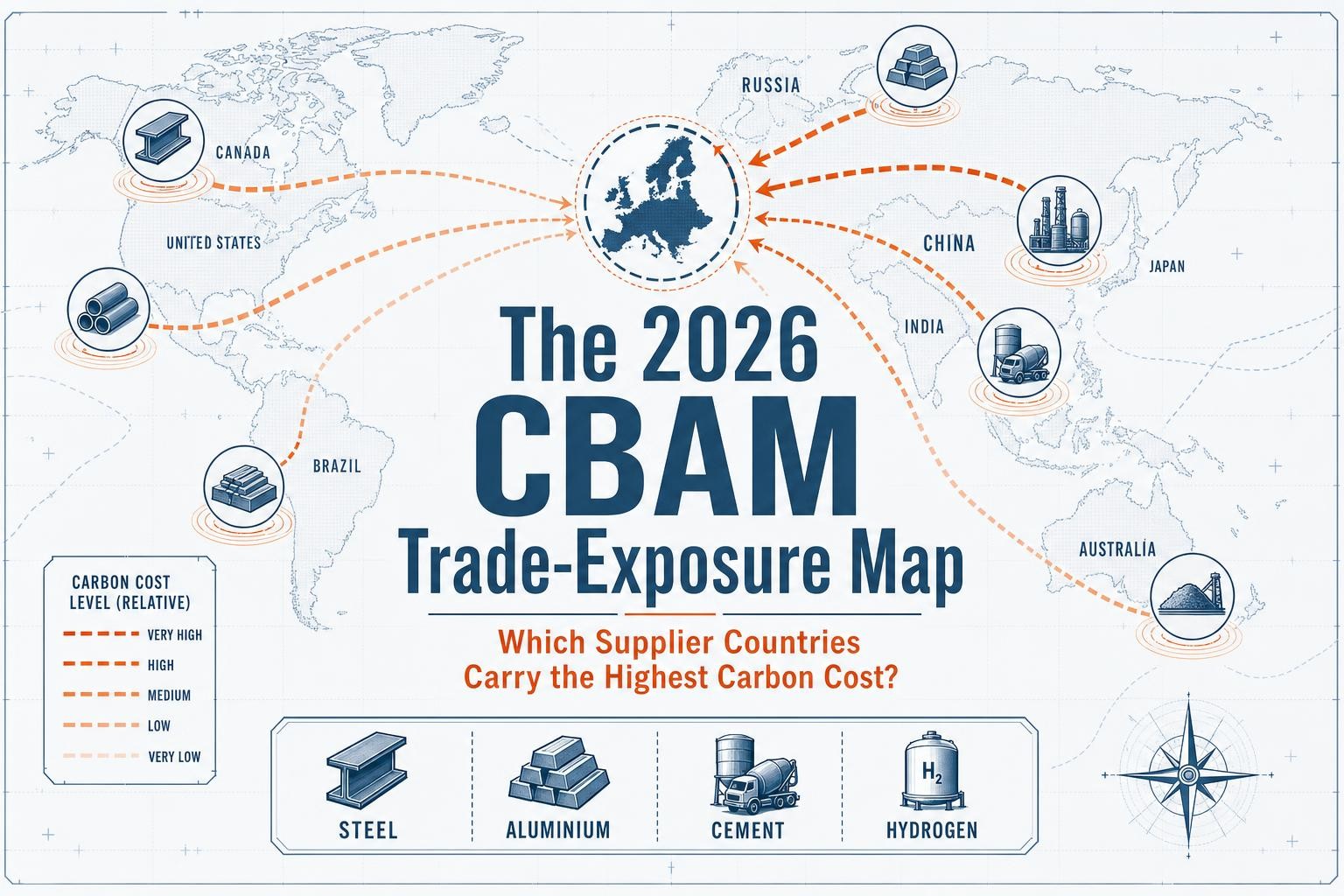
CBAM's 2026 Trade-Exposure Map: Which Supplier Countries Carry the Highest Carbon Cost?
China, India, and Russia dominate EU imports of CBAM goods - but their carbon cost per tonne varies dramatically. Here's how to read the exposure map and what it means for sourcing.
CBAM Circumvention Explained: Resource Shuffling, Slight Modification, and the 2025 Crackdown
The EU's December 2025 CBAM amendment targets resource shuffling, CN-code manipulation, and supply-chain gaming. Here's what counts as circumvention and how to stay on the right side of the line.

Why Your CBAM Bill Doubles by 2030: The ETS Free-Allocation Countdown
Your CBAM cost isn't fixed - it's engineered to rise every year. Here's the exact ETS free-allocation phase-out schedule, the 2029-2030 cliff, and what to do now.