CBAM and Cement: A Plain-English Guide for EU Importers
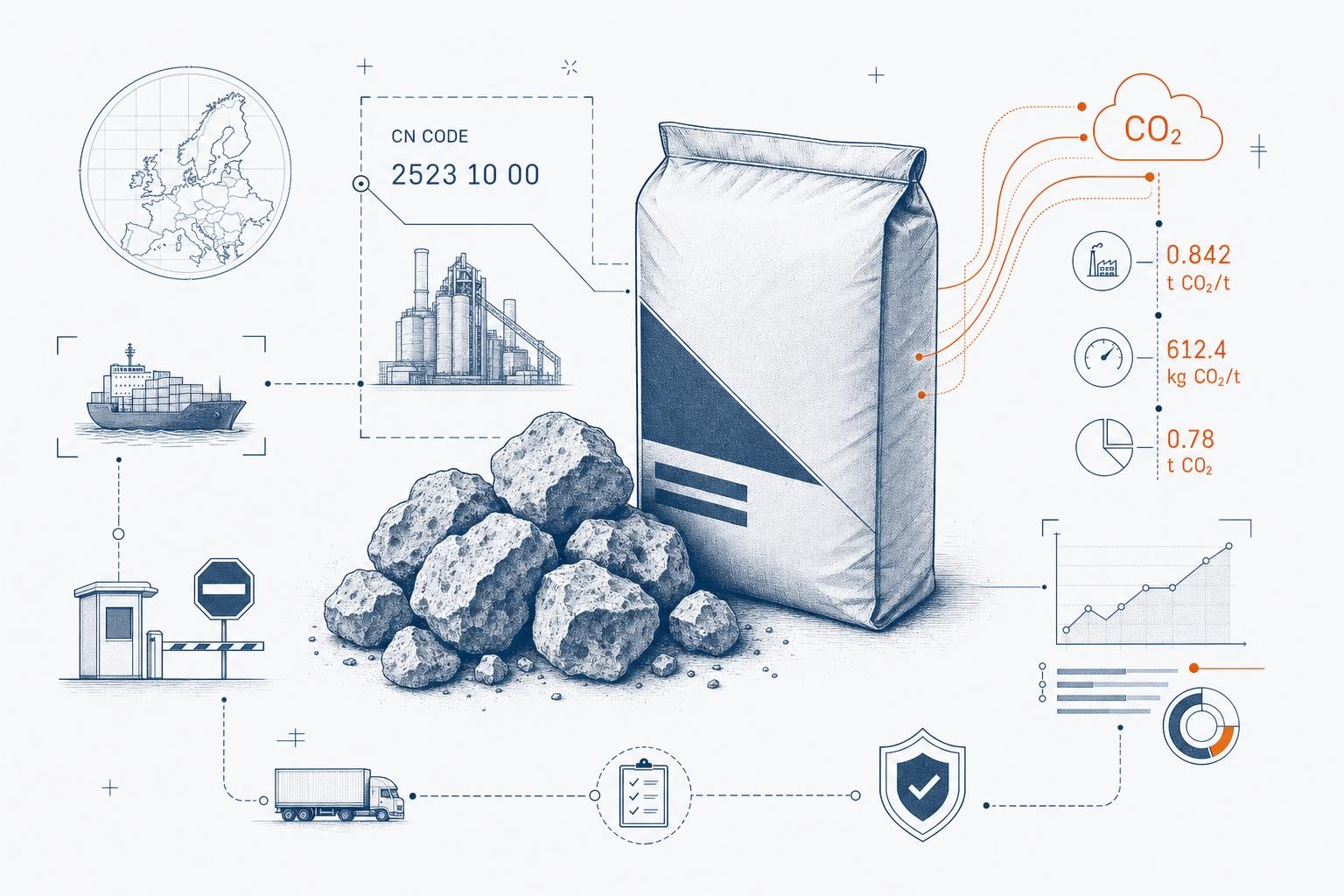
If you import cement or clinker into the EU, the rules changed on 1 January 2026. The transitional phase - quarterly reporting, no financial cost - is over. From now on, every tonne you bring in above the threshold triggers a real certificate obligation, priced against the EU Emissions Trading System (ETS). This guide explains what is in scope, why cement is harder to decarbonise than steel or aluminium, how the default-value penalty works, and what you should do before the first surrender deadline.
What is in scope: CN codes and products
Cement and clinker are one of CBAM's six covered sectors under Regulation (EU) 2023/956. The specific CN codes listed in Annex I are:
Cement and clinker covered under CBAM: CN 2523 10 00 (cement clinker), CN 2523 21 00 (white Portland cement), CN 2523 29 00 (other Portland cement), CN 2523 30 00 (aluminous cement), and CN 2523 90 00 (other hydraulic cements).
A few things worth noting:
- Pure lime, gypsum, and ready-mix concrete are not currently in scope.
- Aluminous cement (CN 2523 30) is included - it is sometimes overlooked by importers who focus only on Portland grades.
- The clinker-to-cement ratio in the final product matters. A CEM I product (95-100% clinker content) carries the highest embedded emissions; a CEM III blend with only 5-64% clinker carries substantially less.
- Unlike steel and aluminium, cement and fertilisers are the only CBAM sectors where both direct and indirect emissions (including electricity consumed in production) are priced.
Scope check. Use the TARIC consultation tool to confirm whether a specific CN code and country of origin combination falls under CBAM. The European Commission's DG TAXUD CBAM pages are the authoritative source.
Why cement is uniquely exposed: the calcination problem
Most carbon-intensive industries can reduce emissions meaningfully by switching to cleaner fuels or buying renewable electricity. Cement cannot - at least not fully - because the majority of its CO₂ comes from a chemical reaction, not a combustion one.
Calcination - the decomposition of limestone (CaCO₃) into calcium oxide (CaO) and CO₂ - accounts for approximately 60-65% of total CO₂ emissions from cement manufacturing, according to Cembureau, the European Cement Association. The remaining ~35% comes from kiln fuel combustion. Switching from coal to gas, or even to hydrogen, eliminates the combustion share but leaves the process emissions entirely untouched.
This has a direct consequence for CBAM: a modern, well-run cement plant using dry-process kilns and alternative fuels will still carry substantial embedded emissions per tonne of clinker. The EU ETS benchmark for grey cement clinker is 0.666 tCO₂ per tonne - a figure that reflects best-available technology, not average performance. Most plants, including efficient ones, sit above it.
For importers, this means there is a floor to how low embedded emissions can be, regardless of how good the supplier's technology is. The only route to near-zero clinker emissions is carbon capture - a technology that is not yet commercially deployed at scale.
How embedded emissions are counted
For cement, embedded emissions are calculated on a clinker-content basis. The functional unit under Implementing Regulation (EU) 2025/2547 is the tonnes of clinker contained in the goods, regardless of whether you are importing clinker directly or finished cement.
The calculation requires:
- Direct process emissions from calcination at the kiln
- Direct combustion emissions from kiln fuel
- Indirect emissions from electricity consumed in production (unique to cement and fertilisers among the six CBAM sectors)
If your supplier provides verified, installation-specific data for all three components, you use those actual values. If they do not - or if the data cannot be independently verified by an accredited verifier - you fall back on the Commission's published default values.
The default-values penalty: how it works and what it costs
Default values are published by the Commission in Implementing Regulation (EU) 2025/2621, released on 31 December 2025 - one day before the definitive phase began. They are set at the average emission intensity of each exporting country, but with a deliberate mark-up to incentivise importers to obtain actual data instead.
For cement, aluminium, and steel, the default-value mark-up is 10% above the country average in 2026, rising to 20% in 2027 and 30% from 2028 onwards.
The practical effect is stark. Turkey is the EU's largest single supplier of cement and clinker. Turkey supplied approximately 4.8 million tonnes of cement and clinker to the EU in 2025, representing roughly 35-39% of total EU cement imports. The Commission did not assign Turkey a country-specific default value, placing Turkish imports in the "other countries" category. The default value applied to Turkish clinker under this classification is 1.551 tCO₂/t - compared to actual emissions reported by Turkish producers during the transitional period of approximately 0.88 tCO₂/t.
The cost consequence is direct. As reported by Argus Media, under current default values, the carbon cost per tonne of Turkish clinker jumps from approximately €20/t to €80/t - a figure that, at February 2026 FOB Turkey prices of $44-48/t, is almost twice the commodity price itself.
The table below illustrates how the mark-up escalates over the three-year ramp:
Note: The chart shows net costs after applying the 2026 CBAM factor of 2.5%. The gross cost gap is much larger - it is the phase-in factor that keeps 2026 net costs modest. By 2030, when the CBAM factor reaches 48.5%, the gap between actual-data and default-value costs becomes commercially decisive.
The data-gap problem: why most importers will be on defaults in 2026
Obtaining verified actual emissions data from a non-EU cement producer is not straightforward. The producer must:
- Monitor and record emissions at installation level, following the methodology in Implementing Regulation (EU) 2025/2547
- Have that data independently verified by an accredited third-party verifier
- Transmit the verified data to the EU importer in a format compatible with the CBAM Registry
As Argus Media reported in March 2026, slow verification timelines and limited accredited verifier capacity could delay registering actual emissions in the CBAM system, meaning European importers are likely to be forced onto punitive default values for their 2026 imports.
TURKCIMENTO, the Turkish Cement Manufacturers' Association, has formally pressed the EU to recognise data from national MRV systems built to EU standards - noting that Turkish producers track emissions through auditable monitoring systems, but that the CBAM default value for Turkey (1.551 tCO₂/t) is nearly double the actual average emissions reported by Turkish producers (0.88 tCO₂/t) during the transitional period.
For EU importers, the practical implication is this: if your supplier cannot provide verified actual data before you file your first CBAM declaration (due by 30 September 2027 for calendar year 2026 imports), you will pay the default-value rate - mark-up included.
What to do first: a practical checklist
Pull your import data by CN code and annual tonnage. Cross-check every code against Annex I of Regulation (EU) 2023/956. The 50-tonne threshold applies per legal entity per calendar year — if you are below it, CBAM obligations do not apply. If you are above it, proceed immediately to step 2.
From 1 January 2026, only authorised CBAM declarants may import CBAM goods into the EU. Apply via the CBAM Registry to your national competent authority (NCA). Processing can take up to 120–180 days. If you have not yet applied, do so now — importers who submitted an application by 31 March 2026 could continue importing while the application was assessed.
Write to your cement and clinker suppliers now. Ask them to confirm whether they are monitoring emissions at installation level under the methodology in Implementing Regulation (EU) 2025/2547, and whether they have — or plan to engage — an accredited third-party verifier. The earlier you start this conversation, the better your chances of having verified data before the September 2027 declaration deadline.
Use the calculator above to quantify your exposure under both scenarios. Run the numbers at current ETS prices and at a stress-tested higher price. The 2026 net cost may look manageable at the 2.5% CBAM factor — but model 2030 at 48.5% to understand the full trajectory. This analysis belongs in your procurement and finance planning now, not in 2027.
Consider adding a CBAM data clause to new or renewing supply agreements. This should require the supplier to provide verified actual emissions data in a specified format, on a specified timeline, and to notify you of any material change in production process that would affect embedded emissions. Allocate the cost risk explicitly — do not leave it ambiguous.
Key deadline: 30 September 2027. This is when the first annual CBAM declaration — covering all 2026 imports — must be submitted and certificates surrendered. The data you collect (or fail to collect) from suppliers throughout 2026 determines whether you pay actual-data rates or default-value rates for that entire year. There is no retroactive correction once the declaration is filed on defaults.
A note on the CBAM factor and the longer trajectory
In 2026, the CBAM factor - the share of embedded emissions that triggers a certificate obligation - is just 2.5%. That keeps net costs modest this year. But the factor rises steeply: to 22.5% by 2029, then 48.5% in 2030, reaching 100% by 2034 as EU ETS free allocation phases out entirely.
For cement importers, this means the cost gap between actual-data and default-value reporting compounds every year. Getting your data infrastructure right in 2026 is not just a compliance exercise - it is a commercial decision that will affect your landed cost and supplier relationships for the rest of the decade.
This is an independent plain-English guide, not official legal or tax advice. The authoritative sources are DG TAXUD's CBAM legislation and guidance pages, Regulation (EU) 2023/956, and Implementing Regulations (EU) 2025/2547 and 2025/2621. Always verify CN codes against Annex I and consult a qualified customs or trade compliance adviser for your specific situation.
Want the CBAM certificate price, rule changes, and compliance deadlines delivered to your inbox? Subscribe to The CBAM Brief - a short, plain-English newsletter for compliance teams.
Related reading
Who Can Actually Accredit Your Supplier's Verifier? Reading the Commission's CBAM Accreditation State-of-Play
The Commission's 25 September accreditation update shows 24 national bodies on board, 15 ready and only 5 taking third-country applications. What that means for suppliers outside the EU and the importers who depend on them.
Norway and Iceland Are Joining CBAM: What the EEA Joint Committee Decisions Change for Importers
On 25 September 2026 the EEA Joint Committee adopted two decisions bringing CBAM to Norway and Iceland. Adoption is not entry into force, though. Here is what is decided, what is pending, and what to watch.
The EU-India Trade Deal Didn't Buy India a CBAM Exemption: What Steel and Aluminium Importers Should Plan For
The EU-India trade agreement cuts tariffs on most goods, but it leaves CBAM untouched. Here is what that means for importers of Indian steel and aluminium, and what to do before the 2026 declaration.