CBAM's Export Problem: Why the Carbon Border Levy Is Only Half Done
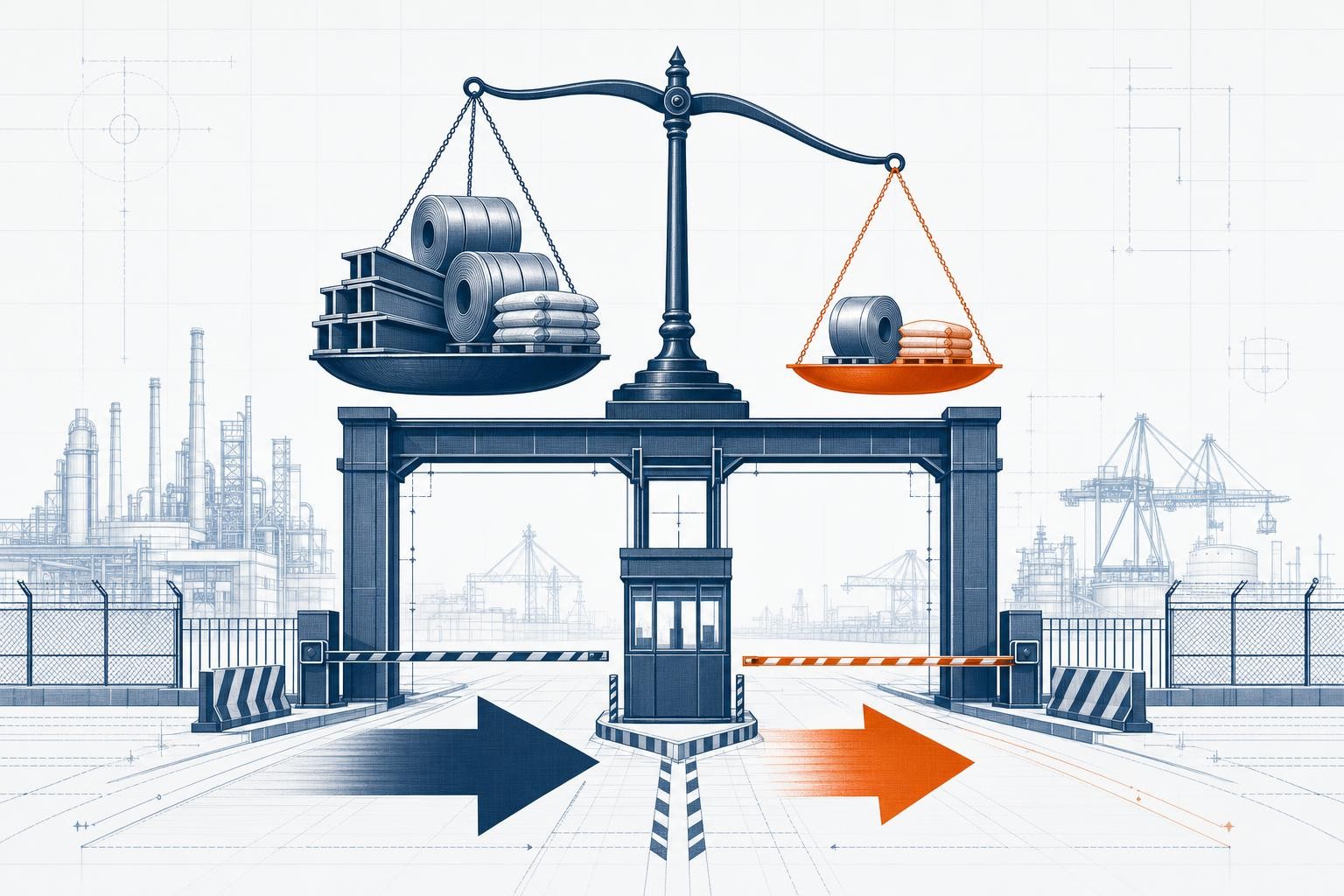
Since 1 January 2026, companies importing steel, aluminium, cement, and fertilisers into the EU have had to pay for the carbon embedded in those goods - a charge that mirrors what EU producers pay under the Emissions Trading System. That is CBAM doing exactly what it was designed to do: level the playing field inside the EU market as free ETS allowances phase out.
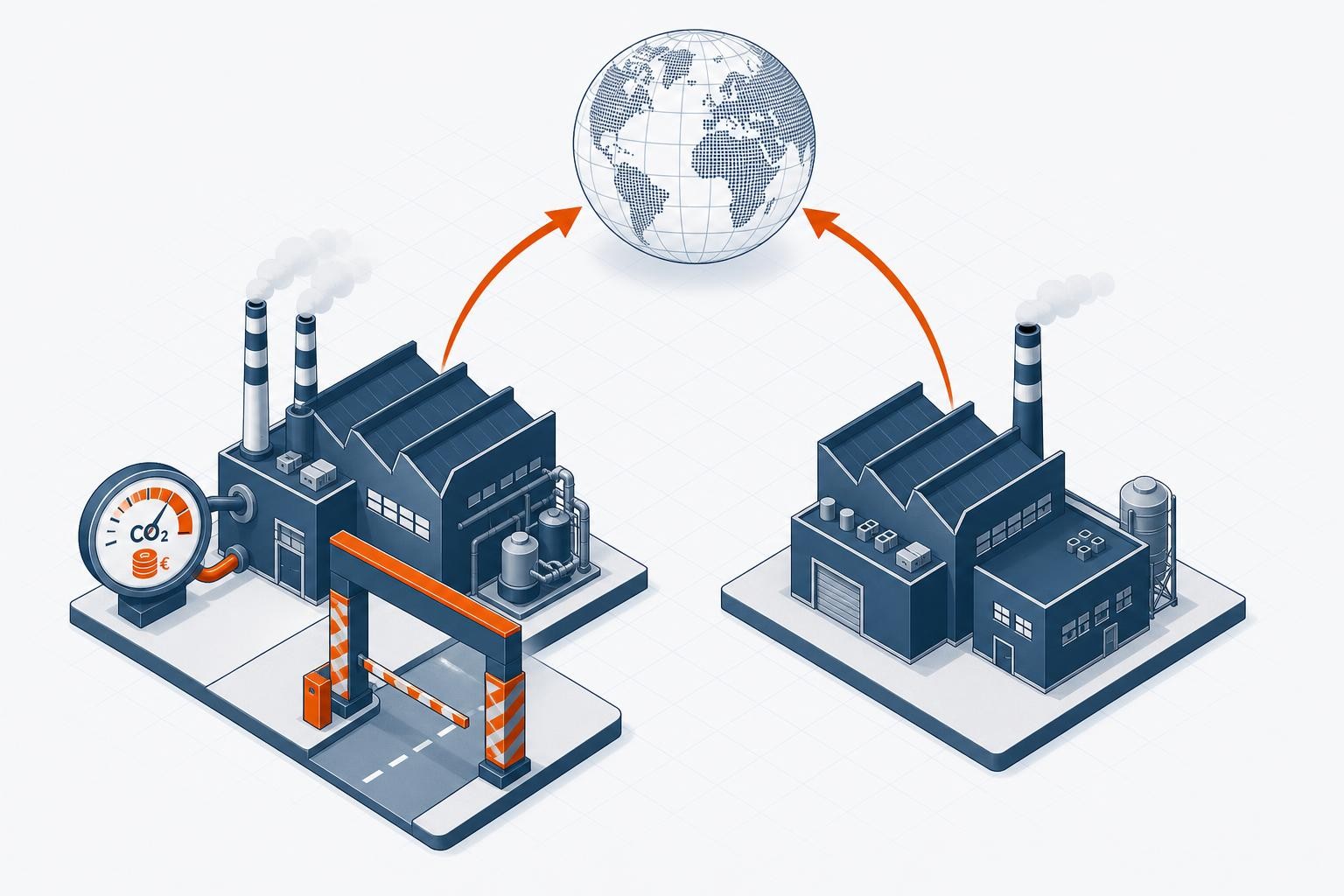
But there is a second playing field that CBAM does not touch. When a European steelmaker or fertiliser producer ships goods out of the EU, it still carries the full weight of EU carbon costs. Its competitors in countries without equivalent carbon pricing do not. As MEP Pascal Canfin put it, the mechanism needs two pillars - one for the domestic market, one for exports - and right now only one pillar is standing.
That gap is the "export problem," and it is driving one of the most contested policy debates in Brussels today.
The Asymmetry, Explained
CBAM works by requiring importers to surrender certificates equal to the embedded emissions of goods they bring into the EU, priced at the prevailing ETS rate. The logic is clean: as free allowances shrink - from 97.5% of benchmarks in 2026 down to zero by 2034 - EU producers pay more for their emissions, and CBAM ensures foreign competitors face the same cost at the EU border.
What CBAM cannot do is follow EU-made goods into export markets. A German steel mill selling to a buyer in Southeast Asia competes against producers who face no carbon price at all. The EU mill has already paid for its emissions under the ETS; it gets no rebate when it exports. Its rival pays nothing.
The ECB has noted this plainly: the current CBAM design "lacks a mechanism, such as export rebates, to level the playing field in EU producers' export markets," leaving EU exporters at a competitive disadvantage in global markets where rivals face no equivalent charges.
Quantifying the Stakes
The European Commission's own 2021 impact assessment put a number on the risk: not providing export rebates could lead to a loss of approximately 6.8% of the EU's export market for affected sectors. That figure, cited by the Niskanen Center, predates the full phase-out of free allowances - meaning the competitive gap will widen as the decade progresses.
The sectors most exposed are those where exports represent a meaningful share of output. In 2018, exports accounted for 22% by value of European steel and iron production, 18% for aluminium, and 14% for fertilisers. These are not niche volumes. And as ABN AMRO's analysis notes, these sectors are "characterized with high competition and low profit margins which make them very sensitive to trade disruptions."
The concern is not purely financial. EUROFER, the European Steel Association, warns that without a structural solution, there is "a real risk of production and emissions moving outside Europe rather than being reduced globally" - a form of carbon leakage that CBAM was specifically designed to prevent, just playing out on the export side rather than the import side.
The Case for Export Rebates
Proponents of export rebates argue the logic is straightforward: if the goal of CBAM is to prevent carbon leakage, then leakage via exports is just as real as leakage via imports. Rebating the carbon cost on exported goods would neutralise the competitive disadvantage without subsidising higher emissions - the EU producer still faces the full ETS price signal for its domestic sales.
ABN AMRO's research suggests that if rebates are designed to be "transparent, non-discriminatory, and linked to emission reductions," the EU can balance economic competitiveness with environmental objectives. Some researchers have proposed "incentive-aligned export adjustment certificates," calculated on ETS product benchmarks and awarded to exporters in exchange for ETS allowances - a mechanism intended to preserve the carbon price signal while offsetting the export disadvantage.
EUROFER's Director General Axel Eggert has been direct: the Commission's December 2025 proposals "correctly identify several loopholes" but "fail to deliver a comprehensive and durable response to carbon and jobs leakage." On exports specifically, EUROFER says the approach "remains piecemeal and lacks a structural solution," with the proposed measures covering less than a quarter of steel exports and lasting only two years.
Where the Commission stands (mid-2026): The December 2025 package did not include a full export rebate mechanism. Instead, the Commission proposed a Temporary Decarbonisation Fund — worth approximately €300 million a year — to offset part of the carbon cost impact on exporters of CBAM-covered goods for 2026 and 2027, conditional on decarbonisation efforts. A longer-term structural solution remains under discussion, with the CBAM review scheduled for 2027.
The Case Against - Three Serious Objections
The counter-arguments are not trivial. Three distinct objections shape the debate.
1. WTO compatibility
This is the most legally acute problem. A scheme that specifically compensates EU producers for cost disadvantages in export markets fits the definition of a prohibited export subsidy under WTO rules. A Centre for European Policy study concluded bluntly that "a scheme that aims to specifically compensate for cost-related disadvantages on export markets would fall under the criteria of the WTO export subsidy ban." The EU would either have to bypass existing agreements or negotiate new multilateral rules - neither of which is quick or certain.
2. Revenue and financing tension
The Commission has proposed that 75% of CBAM revenue go to the EU budget as a new own resource, with 25% going to member states. Diverting a significant share of that revenue to fund export rebates would create a direct conflict: member states would lose income they are counting on, and the EU budget would lose a revenue stream earmarked partly to repay NextGenerationEU. The Commission's own projections put CBAM revenue at around €1.5 billion per year initially - a pool that is modest relative to the scale of compensation the steel and aluminium sectors are seeking.
3. Environmental integrity
This is where environmental groups draw the sharpest line. Bellona's Francesco Lombardi Stocchetti has warned that "the export solution cannot be the Trojan horse, to then have free allowances back in the system for CBAM sectors." The concern is that export rebates - or a return to free allowances for exported goods - would hollow out the ETS price signal for the very sectors it is meant to decarbonise. Carbon Market Watch argues that rebates "would void the price signal provided by the EU ETS" and that sectors receiving free allowances have historically not reduced emissions in line with the Paris Agreement.
There is also a proportionality argument. In 2023, exports of CBAM-covered goods represented just 18% of iron and steel production, 15% of fertilisers, 7% of cement, and 3% of aluminium. Critics argue that blanket export subsidies would be disproportionate to the actual competitive risk, and could entrench carbon-intensive production rather than accelerating the transition.
Competing Perspectives at a Glance
| Dimension | Pro-rebate view | Anti-rebate view |
|---|---|---|
| Carbon leakage | Export leakage is real — production shifts abroad, global emissions rise | Export share is small; leakage risk is overstated relative to domestic market |
| WTO rules | Rebates can be designed to be non-discriminatory and WTO-compatible | Any cost-compensation scheme for exports likely falls under the export subsidy ban |
| ETS integrity | Rebates target exports only, preserving the domestic carbon price signal | Risk of free allowances creeping back; weakens decarbonisation incentives |
| Revenue | CBAM revenue should serve EU industrial competitiveness | Member states and EU budget depend on CBAM revenue; diversion creates conflict |
| Precedent | Other jurisdictions may follow if EU shows it can be done cleanly | Subsidising polluting exports undermines EU's global climate diplomacy |
Where the Debate Stands in 2026
The legislative picture is moving, but no settled outcome exists yet. The Commission's December 2025 package acknowledged the export gap and proposed the Temporary Decarbonisation Fund as a bridge measure. The EU Council adopted its position in June 2026, broadly aligned with the Commission but pushing for a wider downstream product scope. The European Parliament's ENVI committee passed an indicative vote in July; the full Parliament is expected to adopt its position in September, after which trilogue negotiations will begin - with final legislation expected in late 2026 or early 2027.
On the export side specifically, the Council's position has been criticised by EUROFER as failing to provide a long-term structural solution, with the proposed measures "limited both in time, with a duration of only two years, and in product scope, with less than a quarter of steel exports covered." The Commission has signalled it will examine export-side solutions further in the context of the 2027 CBAM review.
This is an open policy debate, not settled law. The outcome will depend on how the EU resolves three genuinely hard trade-offs: WTO legality, budget arithmetic, and environmental credibility.
What Exporters Should Watch
If you produce or trade CBAM-covered goods and export outside the EU, the following developments are the ones that matter most:
- The Temporary Decarbonisation Fund rules - eligibility criteria, product scope, and the decarbonisation conditionality will determine whether your sector qualifies for the 2026-2027 bridge support.
- The 2027 CBAM review - this is where a structural export solution, if any, is most likely to be proposed. The Commission has committed to a new analysis of export-related carbon leakage risk alongside that review.
- ETS free allocation schedule - the pace at which free allowances phase out (2026-2034) directly determines how large the export cost disadvantage becomes. Any adjustment to that schedule would change the calculus.
- WTO dispute outcomes - China, India, and South Africa have challenged CBAM's legality at the WTO. How those cases develop will shape what export-side measures are legally viable.
- Trilogue negotiations (autumn 2026) - the Parliament's position on exports is more ambitious than the Council's; the gap between the two will be negotiated in the coming months.
The Bottom Line
CBAM has done something genuinely significant: it has put a carbon price on imports into the world's largest single market. But its architects always knew the export side was unfinished business. The 6.8% market-loss estimate from the Commission's own impact assessment, the warnings from Eurofer, and the active legislative debate in Brussels all point to the same conclusion - the mechanism is live, but the design is not complete.
The debate over export rebates is not a binary choice between competitiveness and climate. It is a question of whether a WTO-compatible, environmentally credible, and fiscally sustainable mechanism can be designed. That question is now firmly on the legislative agenda, and the answers will emerge over the next 12-18 months.
For EU manufacturers and exporters in CBAM sectors, the time to understand the exposure - and engage with the policy process - is now.
Related reading
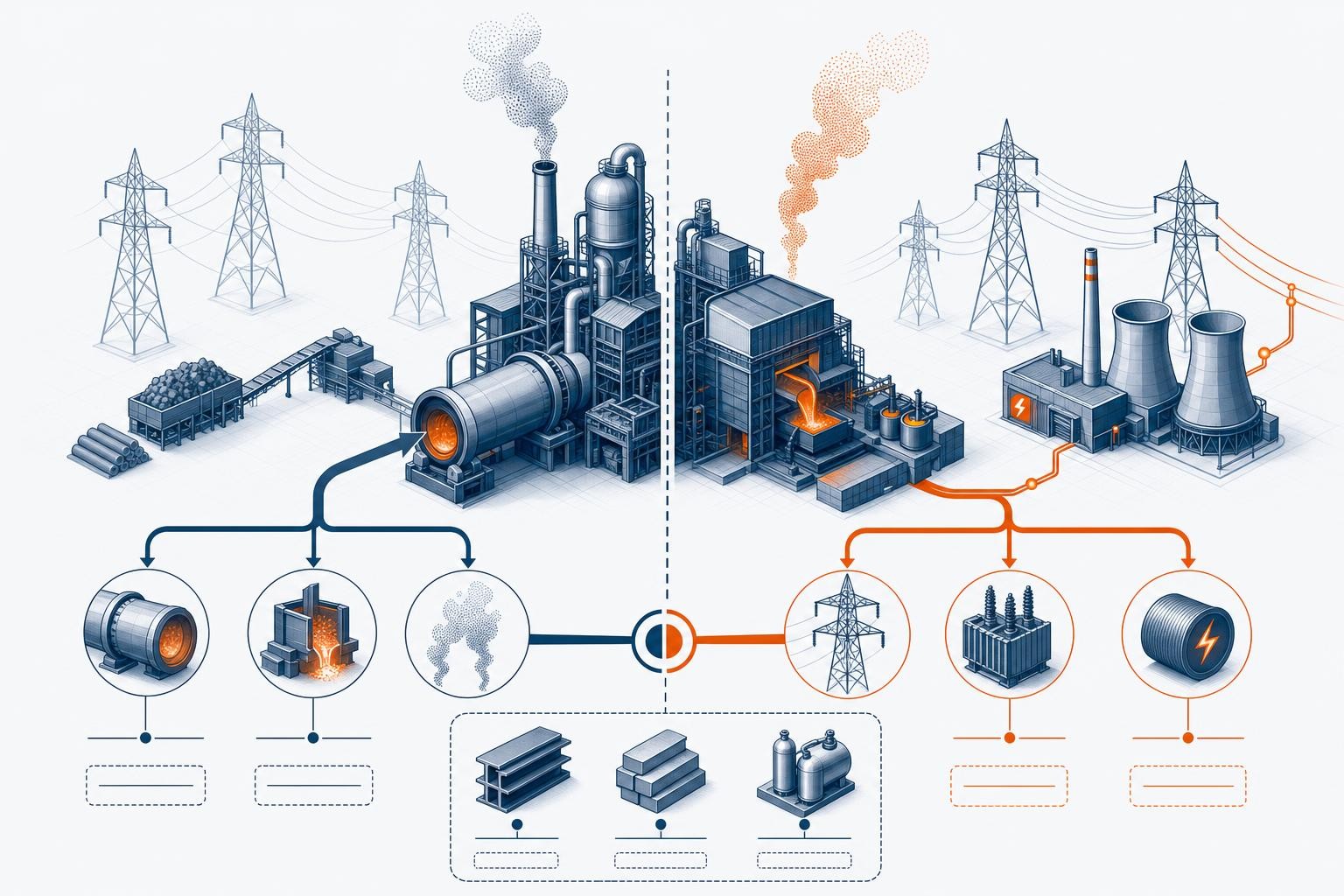
CBAM and Indirect Emissions: Why the Annex II Split Matters for Steel, Aluminium, and Hydrogen Importers
CBAM prices indirect emissions for cement and fertilisers but not for steel, aluminium, or hydrogen - and the reason why matters for your compliance strategy. Here's the full mechanics.
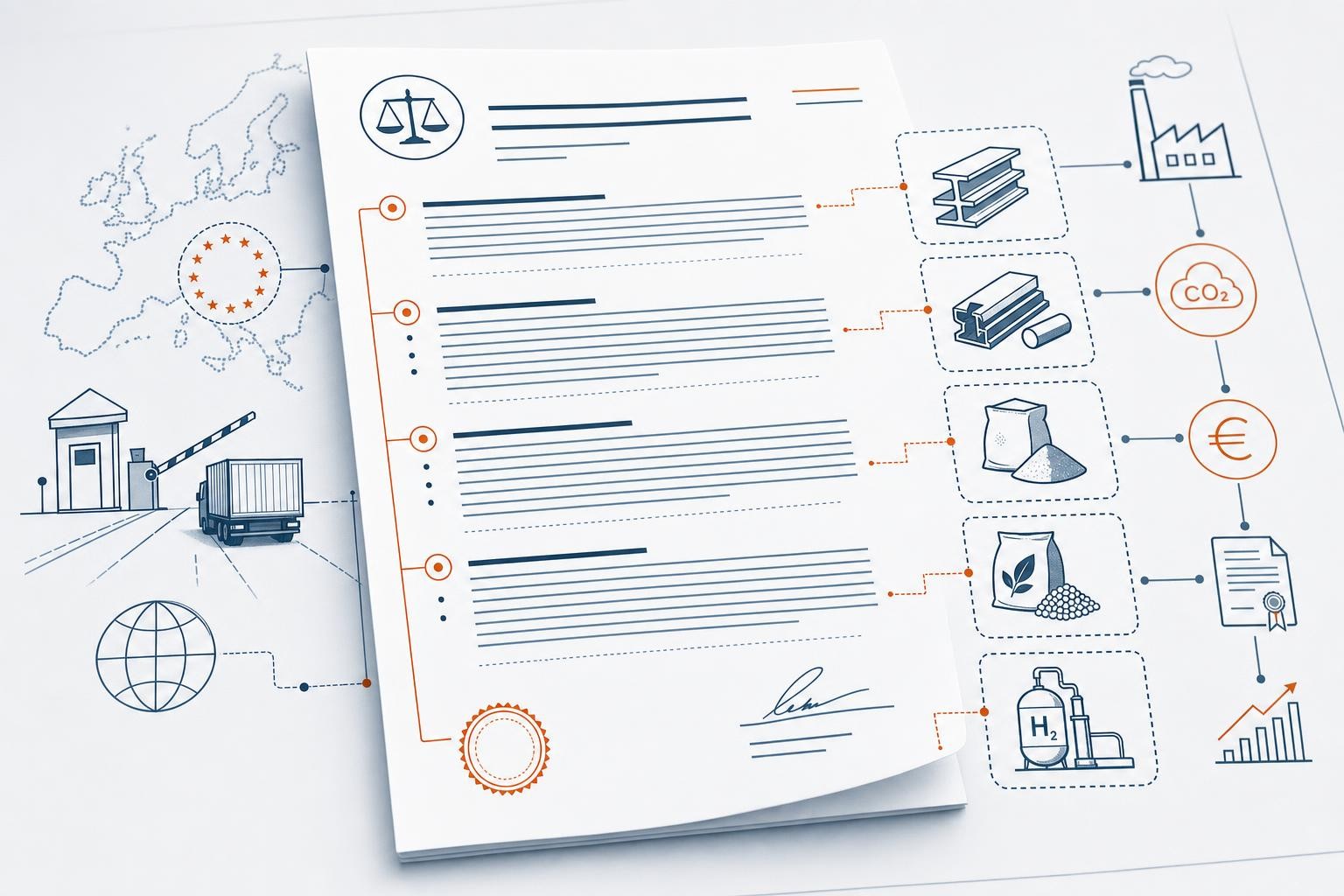
Making Your Supply Contract CBAM-Ready: A Clause-by-Clause Drafting Guide
CBAM is now a contracting problem. This clause-by-clause guide covers emissions data, verification, price pass-through, Incoterms, indemnity, and change-in-law for EU importers of steel, aluminium, cement, fertilisers, and hydrogen.
CBAM and Customs Procedures: How Release for Free Circulation Changes Everything
CBAM obligations attach at release for free circulation, not at physical arrival. That single fact makes your choice of customs procedure a genuine compliance and cash-flow lever. Here's the practical guide.